
An organic compound 'A' on treatment with NH3 gives 'B' which on heating gives 'C', 'C' on treatment with Br2 in the presence of KOH produces ethylamine. Compound 'A' is
Answer & explanation
Correct answer: option 4
The correct answer is option 4. CH3CH2COOH
Let us break down the problem and the reasoning behind identifying compound '\(A\)' as \(CH_3CH_2COOH\) (Propionic acid), based on the given transformations:
Compound '\(A\)' reacts with ammonia \((NH_3)\) to form '\(B\)'. This reaction typically involves the hydrogen of \(-OH\) of '\(A\)' being attacked by ammonia, leading to the formation of ammonium propanoate \((B)\). '\(B\)', formed from the reaction with \(NH_3\), is heated to give '\(C\)', i.e., Propanamide. '\(C\)', which results from the heating process, reacts with bromine \((Br_2)\) in the presence of potassium hydroxide \((KOH)\) to produce ethylamine \((CH_3CH_2NH_2)\). This reaction involves the conversion of the functional group present in 'C' to an amine group.
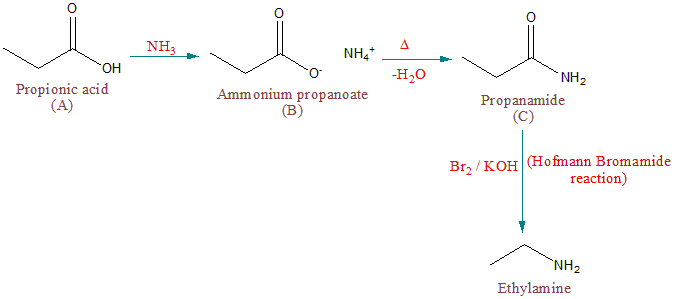
Therefore,\(CH_3CH_2COOH\) (Propionic acid) is identified as compound '\(A\)' based on its ability to undergo the specified reactions leading to the formation of ethylamine. This sequence of reactions is typical in organic chemistry transformations involving carboxylic acids and their derivatives.