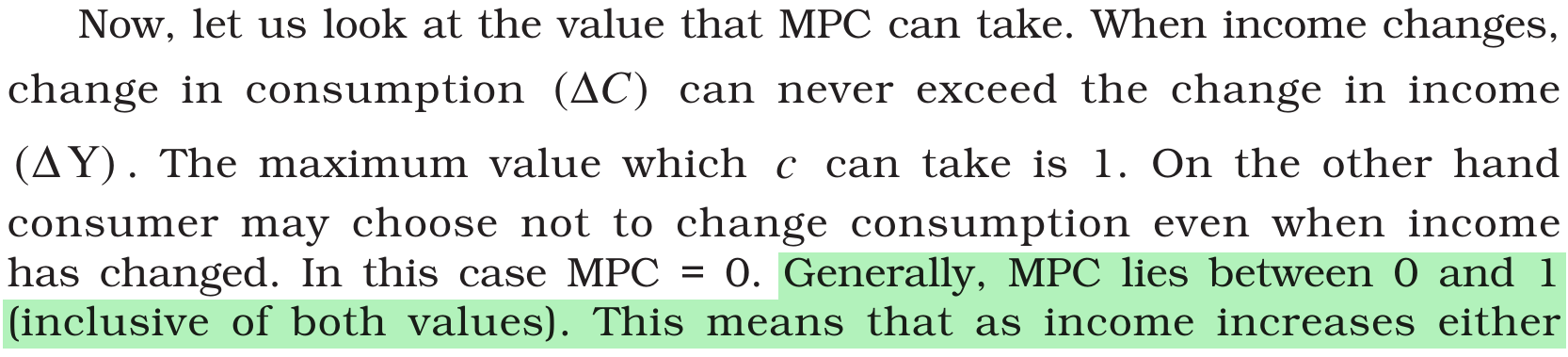
When consumer consumes a part of change in income, which of the following is true?
Answer & explanation
Correct answer: option 4
The correct answer is Option (4) → 0 < MPC < 1
Marginal propensity to consume (MPC) is the change in consumption divided by the change in income. Suppose the consumer spends only a part of the extra income. Then the change in consumption is above zero but below the change in income. So MPC lies between 0 and 1.
Option (1) MPC > 1 — Incorrect. Consumption would have to rise by more than the whole extra income. The highest value MPC can take is 1, when all the extra income is spent.
Option (2) MPC < 1 — Incorrect. MPC < 1 gives only the upper limit. It would hold even at MPC = 0, when the consumer spends none of the extra income, so it does not describe spending ‘a part’ of it.
Option (3) MPC = 0 — Incorrect. Here the consumer does not change consumption at all when income changes.
Option (4) 0 < MPC < 1 — Correct. This states a part of the change in income: more than none and less than all.
NCERT (2026-27): Introductory Macroeconomics — Chapter 4: Determination of Income and Employment
|