Anisole on heating with concentrated HI gives
Answer & explanation
Correct answer: option 3
The correct answer is Option (3) → Phenol and methyl iodide
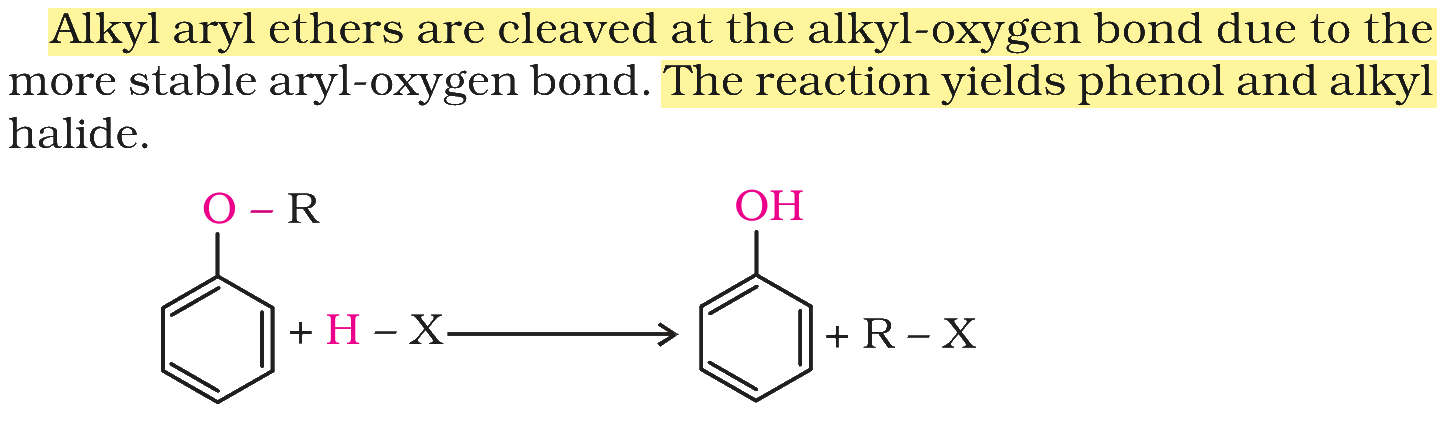
Ethers are cleaved by hot concentrated HI. The ether oxygen is first protonated, and the iodide ion then attacks one of the carbon atoms joined to it. In an alkyl aryl ether the cleavage always occurs at the alkyl–oxygen bond, because the aryl–oxygen bond is stronger: it has partial double-bond character from the delocalisation of the oxygen lone pair into the ring, and the \( sp^2 \) carbon of the ring does not undergo nucleophilic attack.
Protonation of anisole gives the methylphenyl oxonium ion. The iodide ion then attacks the methyl carbon by \( S_N2 \) and phenol leaves, so anisole gives phenol and methyl iodide:
\( \displaystyle \ce{C6H5OCH3 + HI} \xrightarrow{\Delta} \ce{C6H5OH + CH3I} \)
Why the other options are incorrect
Option (1) Iodobenzene — Incorrect. This would need the aryl–oxygen bond to break and iodide to attack a ring carbon, which does not happen.
Option (2) Iodobenzene and methanol — Incorrect. The bonds break the other way round: oxygen stays on the ring and iodine goes to the methyl group.
Option (4) Phenol and methanol — Incorrect. The methyl group leaves as methyl iodide; with excess HI any methanol would itself be converted into \( \ce{CH3I} \). Phenol is not converted further, because its C–O bond is not broken by HI.
NCERT (2026-27 edition):
Cleavage of C–O Bond in Ethers – …