What is formed when acetone reacts with hydrazine?
Answer & explanation
Correct answer: option 3
The correct answer is Option (3) → Acetone hydrazone
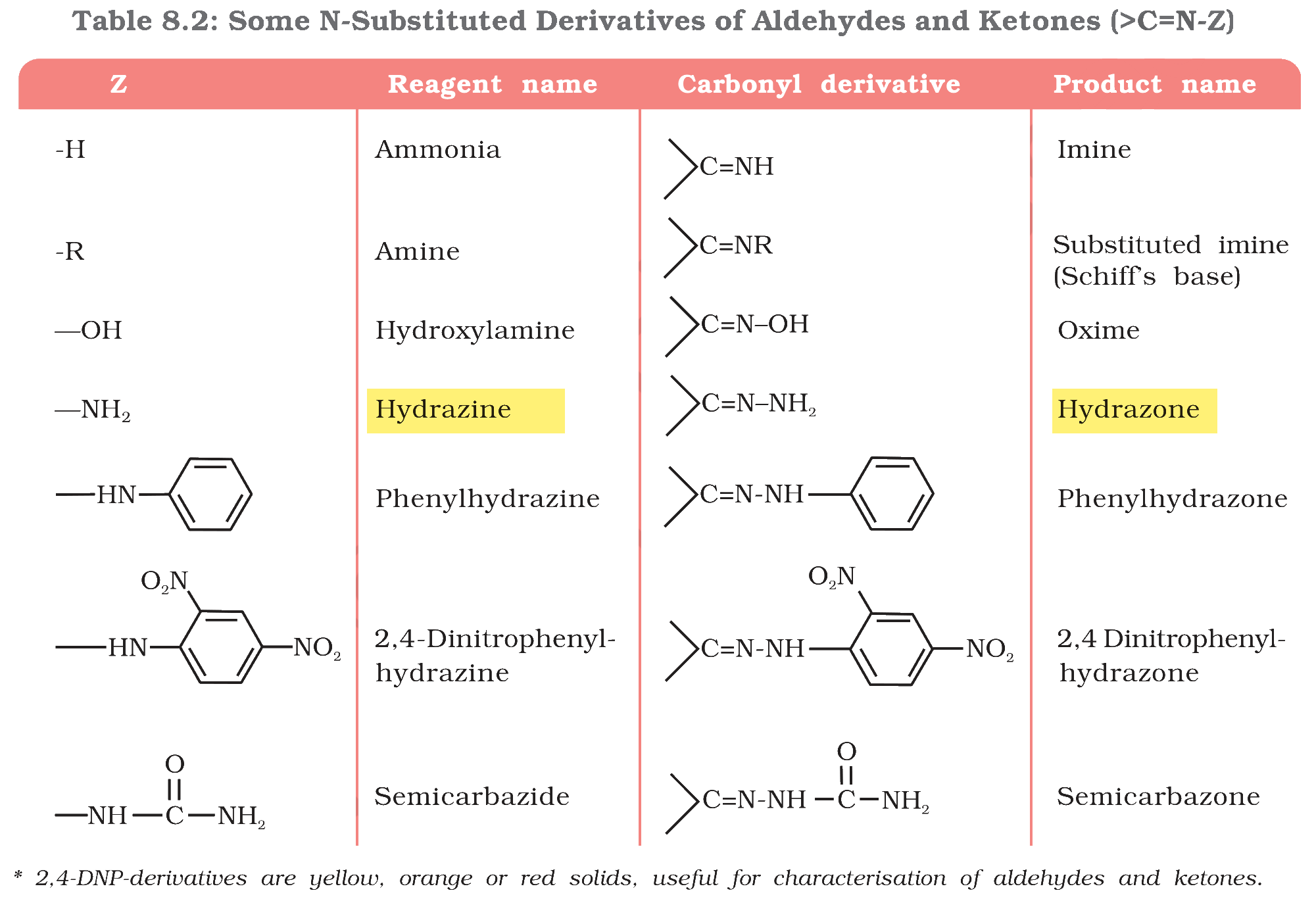
Hydrazine (\( \ce{H2N-NH2} \), Z = –NH2) adds to the carbonyl group of acetone, and the intermediate loses water to give a >C=N–NH2 product, a hydrazone:
\( \displaystyle \ce{(CH3)2C=O + H2N-NH2} \xrightarrow{\ce{H^+}} \ce{(CH3)2C=N-NH2 + H2O} \)
NCERT (2026-27 edition):
8.4 Chemical Reactions – “(e) Addition of ammonia and its derivatives: Nucleophiles, such as ammonia and its derivatives H2N-Z add to the carbonyl group of aldehydes and ketones. The reaction is reversible and catalysed by acid.”
Table 8.2: Some N-Substituted Derivatives of Aldehydes and Ketones (>C=N-Z)