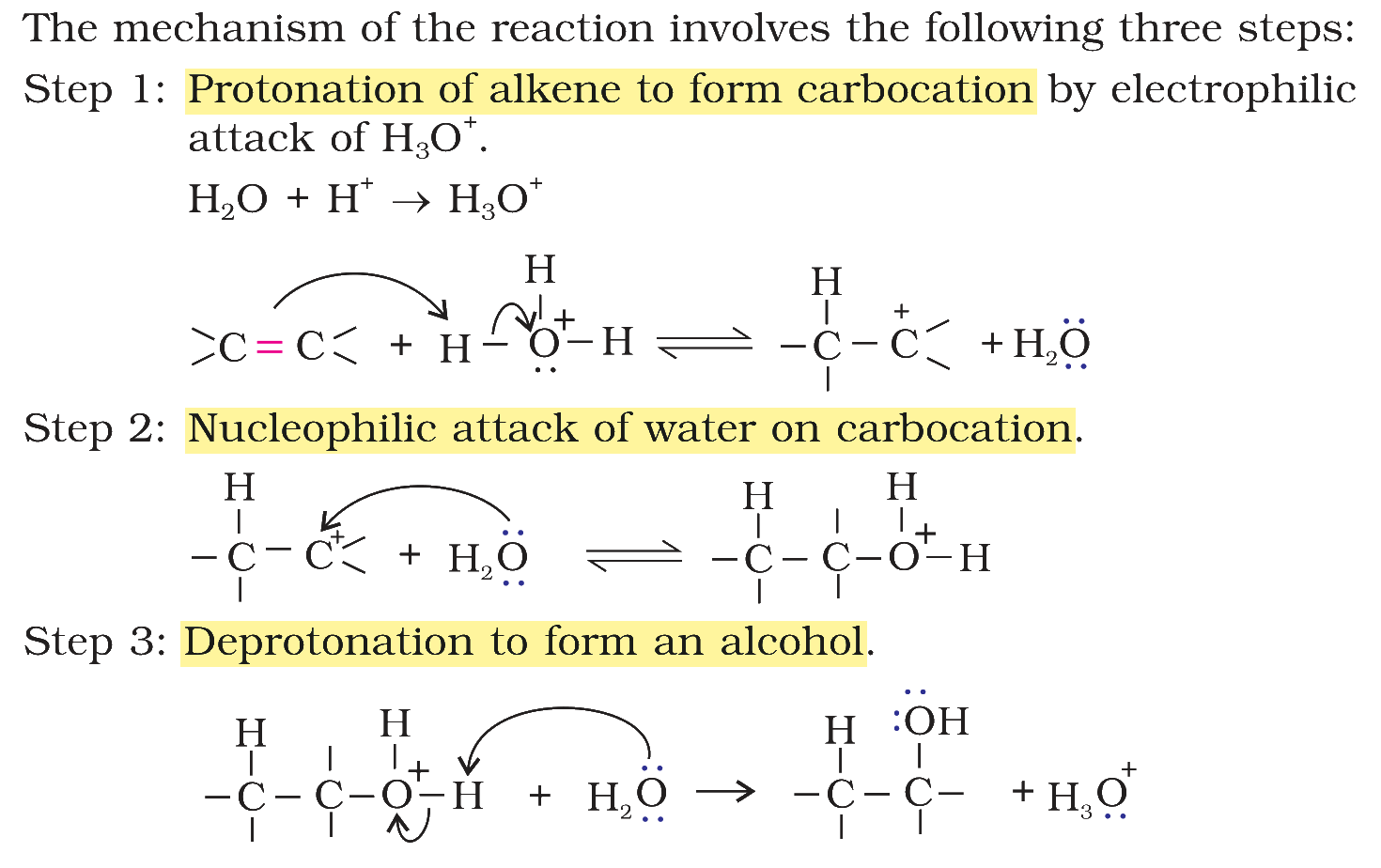
Given below are the three steps which are involved for the conversion of alkene into alcohol. Arrange them in correct sequence.
A. Nucleophilic attack of water on carbocation resulting in deprotonation.
B. Deprotonation to form an alcohol.
C. Protonation of alkene to form carbocation by electrophilic attack of H3O+.
Choose the correct answer from the options given below:
Answer & explanation
Correct answer: option 3
The correct answer is Option (3) → C, A, B
Alkenes add water in the presence of an acid catalyst (\( \ce{H2SO4} \)) to give alcohols, following Markovnikov’s rule. The mechanism has three steps:
C. Protonation of the alkene by the electrophilic attack of \( \ce{H3O^{+}} \) forms a carbocation:
\( \displaystyle \ce{R2C=CR2 + H3O+ -> R2CH-C^+R2 + H2O} \)
A. Water attacks the carbocation as a nucleophile (giving a protonated alcohol):
\( \displaystyle \ce{R2CH-C^+R2 + H2O -> R2CH-CR2(OH2^+)} \)
B. Deprotonation gives the alcohol and regenerates the acid:
\( \displaystyle \ce{R2CH-CR2(OH2^+) + H2O -> R2CH-CR2(OH) + H3O+} \)
Shortcut: The carbocation must form first, so the sequence starts with C; of Options (3) and (4), only Option (3) has the attack of water (A) before deprotonation (B).
NCERT (2026-27 edition):
Mechanism