
A man, 2 m tall, walks at the rate of $1\frac{2}{3}\, m/sec$ towards a street light which is $5\frac{1}{3}\,m$ above the ground. At what rate is the tip of his shadow moving? At what rate is the length of his shadow changing when he is $3\frac{1}{3}\, m$ from the base of light?
Answer & explanation
Correct answer: option 1
The correct answer is Option (1) → The tip of the shadow is moving at $\frac{8}{3}\, m/sec$ and the length of the shadow is changing at $−1\, m/sec$.
Let NL be the street pole, L be the position of the light and MP be the position of the man at any time t and x metres be the distance of the man from street light and y metres be the length of shadow, then $NL=5\frac{1}{3}m=\frac{16}{3} m, MP = 2 m$.
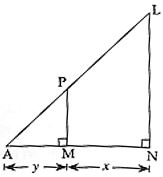
From similar triangles AMP and ANL,
$\frac{AM}{AN}=\frac{MP}{NL}⇒\frac{y}{x + y}=\frac{2}{\frac{16}{3}}$
$⇒\frac{y}{x + y}=\frac{3}{8}⇒8y = 3x + 3y$
$⇒y =\frac{3}{5}x$ ...(i)
Differentiating (i) w.r.t. t, we get
$\frac{dy}{dt}=\frac{3}{5}.\frac{dx}{dt}$ but $\frac{dx}{dt}=1\frac{2}{3}m/sec=\frac{5}{3}m/sec$
$⇒\frac{dy}{dt}=\left(\frac{3}{5}×\frac{5}{3}\right)m/sec=1\,m/sec$
The tip of the shadow is at a distance $(x + y) m$ from street light.
$\frac{d}{dt}(x+y)=\frac{dx}{dt}+\frac{dy}{dt}=\left(\frac{3}{5}+1\right)m/sec=\frac{8}{3}\, m/sec$
Hence, the rate at which the tip of his shadow is moving = $\frac{8}{3}\, m/sec$.
Here, we note that $\frac{dy}{dt} = 1\, m/sec$, which is constant and remains same at all values of x.
Further, as the length of shadow is decreasing, therefore, the rate at which the length of shadow is changing = $-1\, m/sec$.