
The angles of elevation of the top of a tower from two points at a distance of 5 meters and 20 meters along the same straight line from the base of the tower, are complementary. Find the height of the tower.
Answer & explanation
Correct answer: option 1
The correct answer is Option (1) → 10 m
The angle of elevation of the top of a tower from a point on the ground satisfies \(\tan\theta=\frac{\text{height}}{\text{distance from the base}}\). Two angles are complementary when they add up to \(90^\circ\), and \(\tan(90^\circ-\theta)=\cot\theta\); since \(\tan\theta\times\cot\theta=1\), multiplying the two tangent equations removes the angle and leaves only the height.
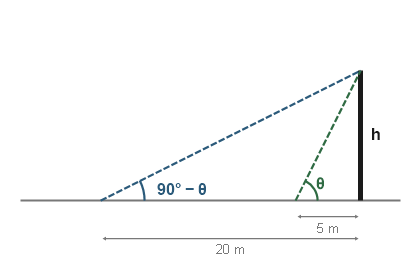
Let the height of the tower be \(h\); the angle is \(\theta\) from the point 5 m away and \(90^\circ-\theta\) from the point 20 m away
From the point 5 m away: \(\displaystyle \tan\theta=\frac{h}{5}\) (1)
From the point 20 m away: \(\displaystyle \tan(90^\circ-\theta)=\cot\theta=\frac{h}{20}\) (2)
Multiplying (1) and (2), the left side \(\tan\theta\times\cot\theta\) becomes 1: \(\displaystyle 1=\frac{h}{5}\times\frac{h}{20}=\frac{h^2}{100}\)
So \(h^2=100\), and the height is \(h=10\,\mathrm{m}\)
Tip: When the angles of elevation from distances \(a\) and \(b\) are complementary, the height is \(\sqrt{ab}\). Here \(\sqrt{5\times20}=\sqrt{100}=10\,\mathrm{m}\).