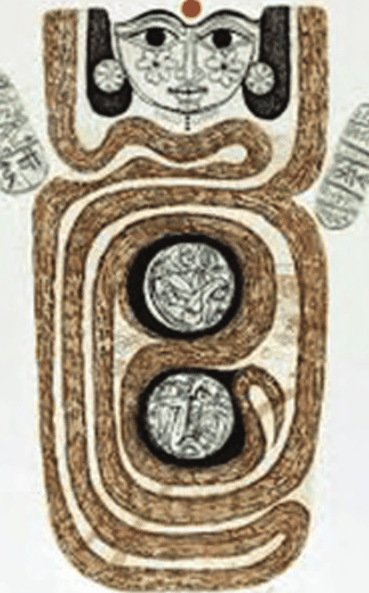
The graphic print "Devi" is made with which technique?
Answer & explanation
Correct answer: option 2
The correct answer is Option (2) → Etching
Note: The given answer is as per the official NTA Answer Key. However, more than one answer is possible: Option (1) and Option (2) are both correct, as explained below.
Devi is an etching on paper made by Jyoti Bhatt in 1970. In etching, lines are bitten into a metal plate with acid. The ink sits in these sunken lines, while the raised surface stays blank, and the press transfers the ink from the lines to the paper.
Option (1) Intaglio — Should also be correct, though not the answer given by NTA. Intaglio is the family of printmaking methods in which the ink is held in lines cut or bitten below the surface of the plate. Etching is one of these methods, so Devi is also an intaglio print.
Option (2) Etching — Correct. Devi is an etching on paper.
Option (3) Screen printing — Incorrect. In screen printing, ink is pushed through a fine mesh screen onto the paper; no metal plate is bitten with acid.
Option (4) Lithography — Incorrect. Lithography prints from a flat stone or plate, using the fact that grease and water do not mix; nothing is cut into the surface.
Advice for the exam: When more than one option is correct, mark the most specific one, here Option (2), Etching, which already implies intaglio. If NTA’s provisional answer key marks a different option, challenge it during the answer-key challenge window, giving proper reasoning. NTA does revise its key when a challenge is well justified, so a sound challenge can raise your marks.
NCERT (2026-27): “Devi This is an etching on paper made by Jyoti Bhatt (1934) in 1970.…”
Devi |