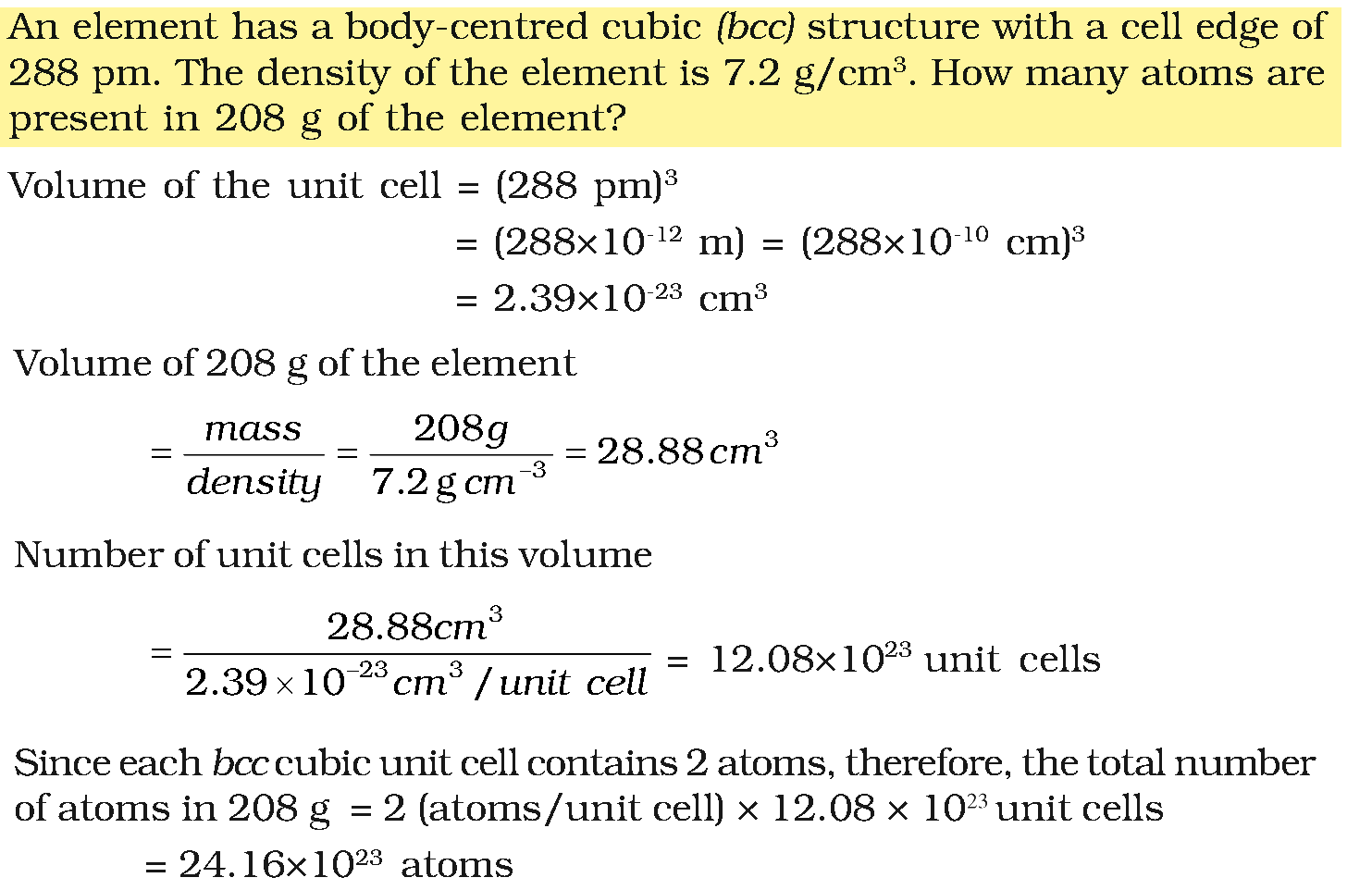
An element ‘Y’ has a body-centred cubic (bcc) structure with a cell edge of 144 pm. The density of the element is 3.6 \(g/cm^3\). How many atoms are present in 700g of the element?
Answer & explanation
Correct answer: option 4
The correct answer is Option (4) → \(13.42 × 10^{25}\)atoms
In a body-centred cubic unit cell there are 8 corner atoms shared by 8 cells and one atom at the body centre, so the number of atoms per unit cell is
\( Z = 8 \times \frac{1}{8} + 1 = 2 \)
The number of atoms in a given mass can be found without the molar mass: find the volume of the sample, the number of unit cells in it, and multiply by Z.
\( a = 144\ \text{pm} = 1.44 \times 10^{-8}\ \text{cm} \)
\( a^3 = (1.44 \times 10^{-8})^3 = 2.986 \times 10^{-24}\ \text{cm}^3 \)
\( \displaystyle \text{Volume of 700 g} = \frac{700\ \text{g}}{3.6\ \text{g cm}^{-3}} = 194.4\ \text{cm}^3 \)
\( \displaystyle \text{Number of unit cells} = \frac{194.4}{2.986 \times 10^{-24}} = 6.51 \times 10^{25} \)
\( \text{Number of atoms} = 2 \times 6.51 \times 10^{25} = 13.0 \times 10^{25} \)
So 700 g of the element contains about 13.0 × 1025 atoms, and the nearest option is 13.42 × 1025; that value is obtained with 720 g (200 cm3).
Note 1: This question is from the pre-rationalised NCERT book (2022-23). The topic is not there in the latest NCERT book (2026-27), and it is also out of the CUET 2026 syllabus.
Note 2: It seems that there is a mistake in the original NTA paper, which prints 700 g when it should read 720 g.
NCERT (Pre-rationalised edition, 2022-23):
Calculations Involving Unit Cell Dimensions – …