
CUETMOCK
  • Pricing
  • Mentors
Log inStart freeStart free mocks→

First test, then trust

Try a free CUET mock test.

Join 5,00,000+ students who rehearsed exam day on the exact NTA screen before sitting CUET. On the web and on Android.

Start free mocks →Get the Android app
CUETMOCK

India's #1 CUET Mock Test Platform. Original NCERT-based questions on the exact NTA exam screen — trusted by 5,00,000+ students since CUET 2022.

Get it onGoogle PlayScan to download the CUETMOCK app

Mock tests

  • CUET mock test series
  • Browse all papers
  • Commerce mocks
  • Humanities (Arts) mocks
  • Science mocks
  • Languages & GAT mocks
  • Free practice questions
  • Pricing

Resources

  • CUET exam guide
  • CUET syllabus
  • Universities accepting CUET
  • Expert blogs
  • News & notifications
  • Webinars & counselling
  • CUET score calculator
  • How we estimate your rank
  • FAQs

Company

  • About us
  • Our leadership & team
  • Our toppers
  • Mentors
  • For schools
  • Contact us
  • Terms
  • Privacy
  • Refund policy

Talk to us

+91 7696 6630 56info@cuetmock.comWhatsApp us

Our other platforms

  • JEE Mock — For IIT-JEE aspirants
  • NEET Mock — For NEET aspirants

Newsletter

Exam updates, study material and offers — no spam.

© 2026 NYC Ventures Pvt. Ltd.

701-702, Royal Business Park, Zirakpur, Punjab - 140603

  • Terms of use
  • Privacy policy
  • Refund policy
  • Contact us

iCUETMOCK is an independent preparation platform, not affiliated with the National Testing Agency (NTA). Always check exam details on the official NTA website.

  • Home
  • Mock tests
  • CUET guide
  • Pricing
  • Log in
Home/Practice questions/Chemistry
ChemistryPhysical: Solutions

Osmotic pressure (Π) of a solution does not depend upon

Read the passage carefully and answer the questions.

The osmotic pressure is one of the four colligative properties which depends on the number of particles of solute in the solution, irrespective of their nature. The osmotic pressure is equal to the product of concentration, gas constant and temperature. It is the most commonly used property for the determination of the molar mass of biomolecules. In many situations, the molecules get dissociated or associated when they are dissolved in a solvent, thereby changing the number of molecules in the solution. As a result, an abnormal molecular mass is obtained. The extent of dissociation or association is given by van't Hoff factor (i), which is the ratio of normal molar mass to abnormal molar mass. It is related with the degree of association or ionization. The introduction of van't Hoff factor in the osmotic pressure equation modifies the equation.

Osmotic pressure (Π) of a solution does not depend upon

Answer & explanation+

Correct answer: option 4

The correct answer is Option (4) → Nature of solute particles.

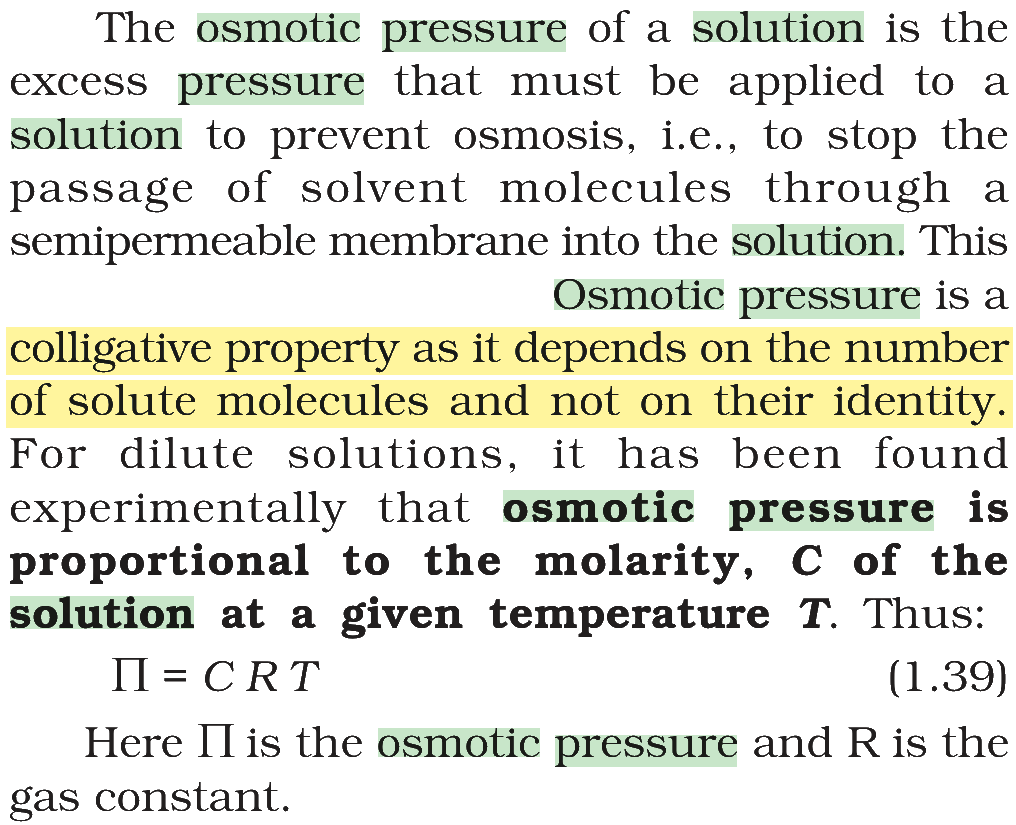
Osmotic pressure is a colligative property: it depends on the number of solute particles in a given volume of solution and not on what those particles are. For a dilute solution:

    \( \displaystyle \pi = C\,R\,T = \frac{n_2}{V}\,R\,T \)

The formula contains the amount of solute (n2), the volume and the temperature, but nothing that describes the chemical nature of the solute. A 0.1 M solution of glucose and a 0.1 M solution of urea have the same osmotic pressure at the same temperature.

  • Option (1) Number of solute molecules. — A factor that osmotic pressure depends on. Osmotic pressure is proportional to n2; this is why a dissociating solute, which gives more particles, shows a higher value.

  • Option (2) Temperature. — A factor that osmotic pressure depends on. π is proportional to the absolute temperature T.

  • Option (3) Concentration of solution. — A factor that osmotic pressure depends on. π is proportional to the molar concentration C.

  • Option (4) Nature of solute particles. — Not a factor that osmotic pressure depends on. As a colligative property it depends only on the number of particles: 0.1 M glucose and 0.1 M urea have the same osmotic pressure at the same temperature.

NCERT (2026-27 edition):
Osmosis and Osmotic Pressure – …
Textbook extract

Advertisement

Practise more on Physical: Solutions

Chapter-wise mocks on the real NTA exam screen, with solutions and your rank. Your first mocks are free.

Start free mocks →

Advertisement

Next questions

  1. Which river is adored by some as ‘the Ganga of the South’?General Aptitude Test · General Knowledge
  2. The given data shows the number of mobiles (in thousands) manufactured by companies C-1, C-2, C-3 and C-4 in 2017, 2018 and 2019. Which com…General Aptitude Test · Quantitative Reasoning
  3. Select the INCORRECTLY spelt word.English · Spelling Check
  4. Indian National Congress was founded in which year?General Aptitude Test · General Knowledge
  5. Find the average of squares of natural numbers till 7.General Aptitude Test · Numerical Ability
  6. What do you mean by “Global South”?Political Science · Contemporary World Politics: Environment and Natural Resources
  7. Which is not a part of a transcription unit in DNA ?Biology · Molecular Basis of Inheritance
  8. Identify the correct statement in relation to productivity in an aquatic ecosystem.Biology · Ecosystem
  9. "Healthy States, Progressive India" Report has been published by which of the following institution?General Aptitude Test · General Knowledge
  10. Select the option that expresses the given sentence in passive voice. Their behaviour vexes us.English · Grammar: Active Passive Voice