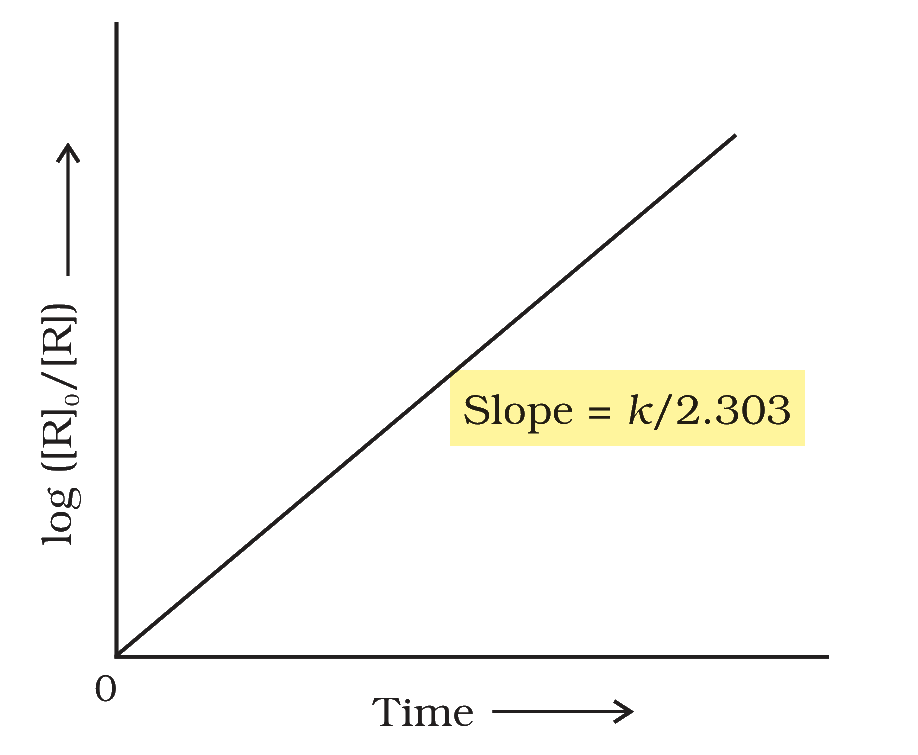
For the graphical representation of the first-order reaction
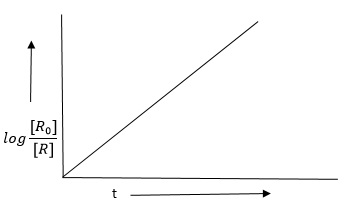
The slope of the straight line is
Answer & explanation
Correct answer: option 3
The correct answer is Option (3) → \(\frac{k}{2.303}\)
The integrated rate equation of a first order reaction is
\( k = \displaystyle\frac{2.303}{t}\log\displaystyle\frac{[R]_0}{[R]} \)
Rearranging:
\( \log\displaystyle\frac{[R]_0}{[R]} = \displaystyle\frac{k}{2.303}\,t \)
This has the form y = mx, so a plot of log([R]0/[R]) against t is a straight line through the origin with slope = k/2.303.
Why the other options are incorrect
Option (1) \(k\) — Incorrect. k is the slope when the natural logarithm, ln([R]0/[R]), is plotted against t; the graph here uses log to base 10.
Option (2) \(-k\) — Incorrect. −k is the slope of ln[R] against t (and of [R] against t for a zero order reaction), not of this plot.
Option (4) \(\frac{-k}{2.303}\) — Incorrect. −k/2.303 is the slope of log[R] against t, which falls with time; log([R]0/[R]) rises with time, so its slope is positive.
NCERT (2026-27 edition):
First Order Reactions – “… The first order rate equation (3.10) can also be written in the form
\( \displaystyle k = \frac{2.303}{t}\log\frac{[R]_0}{[R]} \) (3.15)
… If we plot a graph between log [R]0/[R] vs t, (Fig. 3.5), the slope = k/2.303”