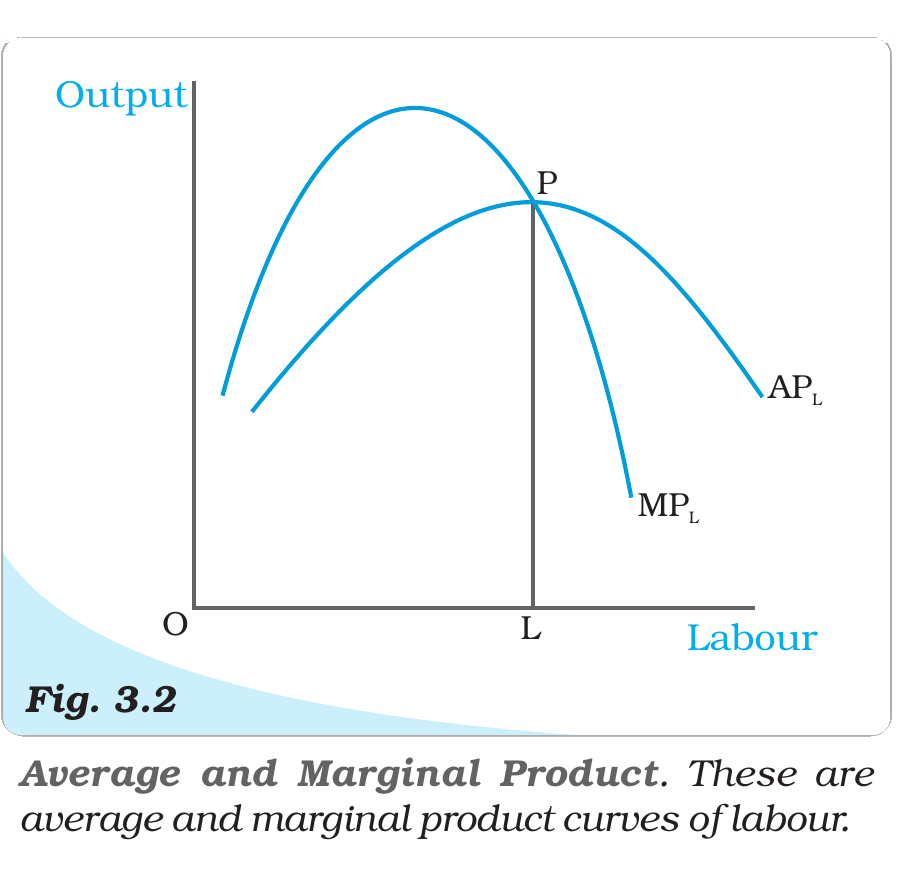
The marginal product of an input initially rises and then after a certain level of employment, it starts falling, thus MP curve looks like an inverse 'U'-shaped curve. This condition is under _____.
Answer & explanation
Correct answer: option 2
The correct answer is Option (2) → Law of Variable Proportions.
The tendency of the marginal product (MP) to first rise and then fall is the law of variable proportions. It gives the MP curve the shape of an inverse ‘U’.
The law works when one input is fixed and the other is increased. Suppose a farmer keeps the land fixed and adds workers one by one. At first the mix of land and workers becomes more suitable, so MP rises. After a certain level, the land becomes too crowded with workers, so MP falls.
Option (1) Decreasing Returns to Scale. — Incorrect. Returns to scale apply when all inputs are raised in the same proportion. With decreasing returns, output rises by a smaller proportion than the inputs.
Option (2) Law of Variable Proportions. — Correct. One input is held fixed, so the proportion between the inputs changes as the other input grows.
Option (3) Increasing Returns to Scale. — Incorrect. All inputs are raised in the same proportion, and output rises by a larger proportion.
Option (4) Constant Returns to Scale. — Incorrect. All inputs are raised in the same proportion, and output rises by that same proportion.
Note: A same/similar question was asked in CUET (UG) in the papers below.
| 2026 | 2025 | 2024 | 2023 | 2022 |
| 13-05 S2* 06-06 S1* | 13-05 S2* 27-05 S2 28-05 S2* | – | – | – |
* A similar question.
NCERT (2026-27): “3.4 The Law of Diminishing Marginal Product and the Law of Variable Proportions … Notice that the MP first increases (upto 3 units of labour) and then begins to fall. This tendency of the MP to first increase and then fall is called the law of variable proportions or the law of diminishing marginal product. Law of variable proportions say that the marginal product of a factor input initially rises with its employment level. But after reaching a certain level of employment, it starts falling.… …As we hold one factor fixed and keep increasing the other, the factor proportions change. Initially, as we increase the amount of the variable input, the factor proportions become more and more suitable for the production and marginal product increases. But after a certain level of employment, the production process becomes too crowded with the variable input.… …According to the law of variable proportions, the marginal product of an input initially rises and then after a certain level of employment, it starts falling. The MP curve therefore, looks like an inverse ‘U’-shaped curve as in figure 3.2.… 3.6 Returns to Scale …When a proportional increase in all inputs results in an increase in output by the same proportion, the production function is said to display Constant returns to scale (CRS). When a proportional increase in all inputs results in an increase in output by a larger proportion, the production function is said to display Increasing Returns to Scale (IRS)… …Decreasing Returns to Scale (DRS) holds when a proportional increase in all inputs results in an increase in output by a smaller proportion.…”
|