
The correct order of decreasing $pk_a$, values of the following compounds
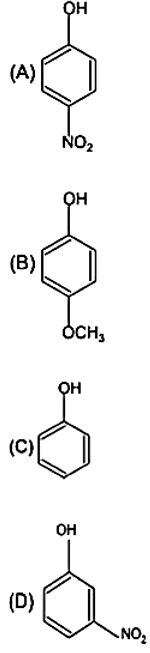
Choose the correct answer from the options given below:
Answer & explanation
Correct answer: option 1
The correct answer is Option (1) → (B), (C), (D), (A)
Core Concept:
Electron withdrawing groups decrease pKa (increase acidity), while electron donating groups increase pKa (decrease acidity).
Explanation:
Methoxy group (–OCH₃) donates electrons through resonance, reducing acidity and increasing pKa.
Nitro group (–NO₂) withdraws electrons through –I and –R effects, increasing acidity and lowering pKa.
o-Nitrophenol is slightly less acidic than p-nitrophenol due to intramolecular hydrogen bonding reducing ionization.
Step 1: Identify the Compounds
The compounds shown in the question are substituted phenols:
$\textbf{(A):}$ p-nitrophenol (4-nitrophenol)
$\textbf{(B):}$ p-methoxyphenol (4-methoxyphenol)
$\textbf{(C):}$ m-nitrophenol (3-nitrophenol)
$\textbf{(D):}$ o-nitrophenol (2-nitrophenol)
Step 2: Understand the Relationship Between Acidity and pKa
$\textbf{Acidity}$ is the ability of a compound to donate a proton ($H^{+}$).
$\textbf{pKa}$ is the negative logarithm of the acid dissociation constant ($K_{a}$).
The relationship is inverse: a $\textbf{lower pKa}$ value indicates a $\textbf{stronger acid}$, while a $\textbf{higher pKa}$ value indicates a $\textbf{weaker acid}$.
Step 3: Analyze Electronic Effects of Substituents
- Electron-Withdrawing Groups (EWG): Groups like nitro ($-NO_2$) withdraw electron density from the ring. This stabilizes the negative charge on the phenoxide ion (the conjugate base), making the original phenol more acidic (lower $pK_a$).
- Electron-Donating Groups (EDG): Groups like methoxy ($-OCH_3$) donate electron density. This destabilizes the phenoxide ion, making the phenol less acidic (higher $pK_a$).
Step 4: Compare Specific Positions
1. Nitrophenols ($-NO_2$ isomers):
- p-Nitrophenol (A): The nitro group at the para position exerts both a strong inductive effect ($-I$) and a strong resonance effect ($-R$ or $-M$). This makes it the strongest acid among the given nitrophenols, with a $pK_a$ of approximately 7.1.
- o-Nitrophenol (D): Similar to the para isomer, it has both $-I$ and $-R$ effects. However, it is slightly less acidic than p-nitrophenol because of intramolecular hydrogen bonding between the $-OH$ and $-NO_2$ groups, which makes it slightly harder to lose the proton. Its $pK_a$ is approximately 7.2.
- m-Nitrophenol (C): At the meta position, the nitro group only exerts an inductive effect ($-I$) and cannot stabilize the negative charge through resonance. Thus, it is significantly less acidic than the ortho and para isomers, with a $pK_a$ of approximately 8.3.
2. p-Methoxyphenol (B): The methoxy group is an EDG due to its strong resonance effect ($+R$ or $+M$), which destabilizes the phenoxide ion more than any other group in this set. This makes it the weakest acid (highest $pK_a$), with a $pK_a$ of approximately 10.2.
Step 5: Determine the Order of Decreasing $pK_a$
To find the order of decreasing $pK_a$, we arrange them from the weakest acid (highest $pK_a$) to the strongest acid (lowest $pK_a$):
- p-Methoxyphenol (B): $pK_a \sim 10.2$
- m-Nitrophenol (C): $pK_a \sim 8.3$
- o-Nitrophenol (D): $pK_a \sim 7.2$
- p-Nitrophenol (A): $pK_a \sim 7.1$
Option (C) Phenol
Has no substituent, so it has the highest pKa among the given compounds.
Option (D) o-Nitrophenol
Nitro group increases acidity but intramolecular hydrogen bonding stabilizes neutral form, giving slightly higher pKa than p-isomer.
Option (A) p-Nitrophenol
Strong electron withdrawing nitro group stabilizes phenoxide ion, lowering pKa further.
Option (B) p-Methoxyphenol
Methoxy group donates electrons, destabilizing phenoxide ion, giving highest pKa.