Financial leverage is associated with which of the following?
(A) \( \frac{\text{Debt}}{\text{Debt + Capital}} \)
(B) \( \frac{\text{Debt}}{\text{Equity}} \)
(C) \( \frac{\text{Equity}}{\text{Debt + Capital}} \)
(D) \( \frac{\text{Debt}}{\text{Debt + Equity}} \)
Choose the correct answer from the options given below:
Answer & explanation
Correct answer: option 4
The correct answer is Option (4) → (B) and (D) only
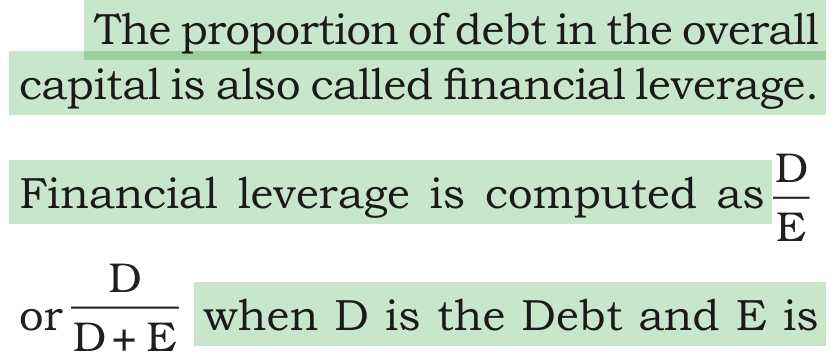
The proportion of debt in the overall capital is called financial leverage. It is computed as Debt ÷ Equity or Debt ÷ (Debt + Equity), where D is the Debt and E is the Equity.
(A) Debt ÷ (Debt + Capital) — Not a measure of financial leverage (Incorrect). Debt is divided by equity or by debt plus equity. “Debt + Capital” is not one of the two formulas.
(B) Debt ÷ Equity — A measure of financial leverage (Correct). This is the first formula.
(C) Equity ÷ (Debt + Capital) — Not a measure of financial leverage (Incorrect). Financial leverage shows the share of debt. Here equity is on top, so it does not show the share of debt.
(D) Debt ÷ (Debt + Equity) — A measure of financial leverage (Correct). This is the second formula. It shows what part of the total capital is debt.
NCERT (2026-27 Edition):
|