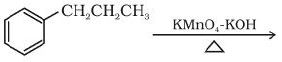
What is the major product of the following reaction?
Answer & explanation
Correct answer: option 2
The correct answer is Option (2) → benzoic acid (\( \ce{C6H5COOH} \))
The attack starts at the benzylic carbon, so propylbenzene loses two of its three side-chain carbons as \( \ce{CO2} \). In alkaline \( \ce{KMnO4} \) the acid is first obtained as its potassium salt, and acidification gives benzoic acid:
\( \displaystyle \ce{C6H5CH2CH2CH3} \xrightarrow[\Delta]{\ce{KMnO4-KOH}} \ce{C6H5COO^-K+} \xrightarrow{\ce{H3O+}} \ce{C6H5COOH} \)
So the major product is benzoic acid.
Why the other options are incorrect
Option (1) 3-phenylpropanoic acid (\( \ce{C6H5CH2CH2COOH} \)) — Incorrect. This keeps the whole three-carbon chain and oxidises only its end; in fact the attack starts at the benzylic carbon and the chain is cut there.
Option (3) phenylacetic acid (\( \ce{C6H5CH2COOH} \)) — Incorrect. It still has a \( \ce{CH2} \) group next to the ring, which would itself be oxidised under these conditions.
Option (4) phenylacetone (\( \ce{C6H5CH2COCH3} \)) — Incorrect. A ketone in the chain is not the end product of vigorous side-chain oxidation; the chain is oxidised all the way to –COOH on the ring.
NCERT (2026-27 edition):
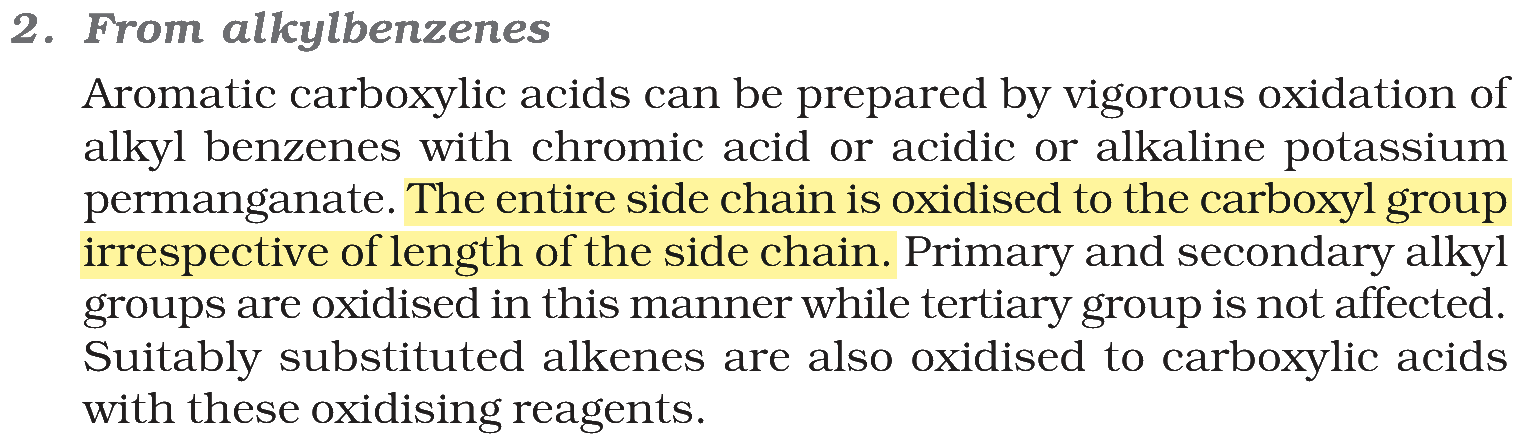
From Alkylbenzenes