Which types of bonds or interactions are found in the β-helix of protein?
Answer & explanation
Correct answer: option 3
The correct answer is Option (3) → H-bond
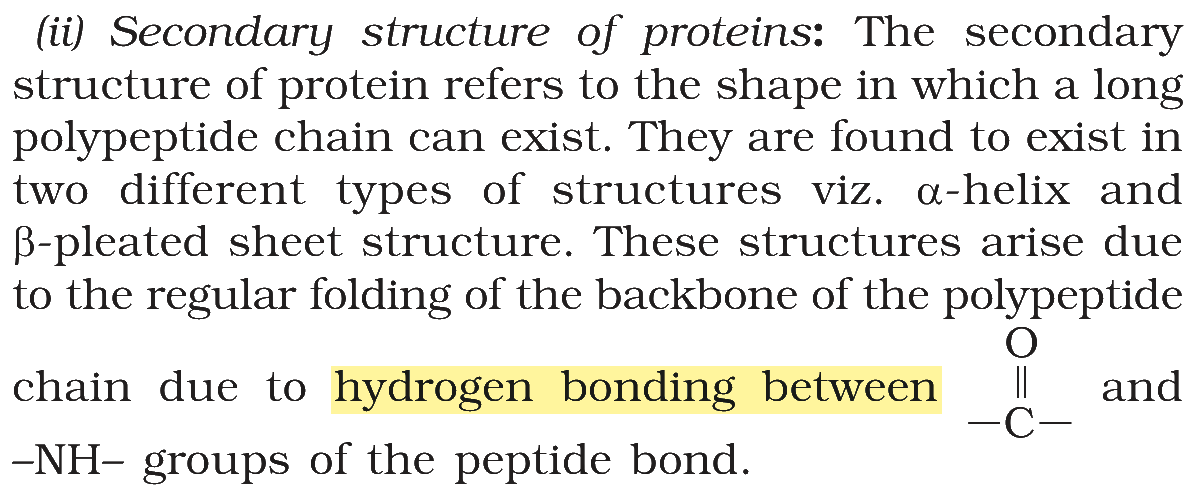
The secondary structure of a protein is the shape the long polypeptide chain takes up. It exists in two forms, the α-helix and the β-pleated sheet, and both arise from the regular folding of the backbone through hydrogen bonds between the C=O group of one peptide bond and the N–H group of another.
In the α-helix the chain twists into a right-handed coil, and the N–H of each amino acid residue is hydrogen bonded to the C=O of the turn next to it. In the β-pleated sheet the chains lie side by side and are held together by hydrogen bonds between neighbouring chains. In either case, the interaction is the hydrogen bond.
Why the other options are incorrect
Option (1) Ionic bond — Incorrect. Ionic (electrostatic) attractions between charged side chains help hold the tertiary structure, not the helix of the backbone.
Option (2) Covalent interaction — Incorrect. The covalent peptide bonds make the primary structure, the sequence of amino acids; the folding into a helix is due to weaker hydrogen bonds.
Option (4) Banana bond — Incorrect. This is the three-centre two-electron bond in diborane, \( \ce{B2H6} \); it has nothing to do with proteins.
Note: It seems that there is a mistake in the original NTA paper, which prints β-helix; the secondary structures of proteins are the α-helix and the β-pleated sheet.
NCERT (2026-27 edition):
Secondary Structure of Proteins