
CUETMOCK
  • Pricing
  • Mentors
Log inStart freeStart free mocks→

First test, then trust

Try a free CUET mock test.

Join 5,00,000+ students who rehearsed exam day on the exact NTA screen before sitting CUET. On the web and on Android.

Start free mocks →Get the Android app
CUETMOCK

India's #1 CUET Mock Test Platform. Original NCERT-based questions on the exact NTA exam screen — trusted by 5,00,000+ students since CUET 2022.

Get it onGoogle PlayScan to download the CUETMOCK app

Mock tests

  • CUET mock test series
  • Browse all papers
  • Commerce mocks
  • Humanities (Arts) mocks
  • Science mocks
  • Languages & GAT mocks
  • Free practice questions
  • Pricing

Resources

  • CUET exam guide
  • CUET syllabus
  • Universities accepting CUET
  • Expert blogs
  • News & notifications
  • Webinars & counselling
  • CUET score calculator
  • How we estimate your rank
  • FAQs

Company

  • About us
  • Our leadership & team
  • Our toppers
  • Mentors
  • For schools
  • Contact us
  • Terms
  • Privacy
  • Refund policy

Talk to us

+91 7696 6630 56info@cuetmock.comWhatsApp us

Our other platforms

  • JEE Mock — For IIT-JEE aspirants
  • NEET Mock — For NEET aspirants

Newsletter

Exam updates, study material and offers — no spam.

© 2026 NYC Ventures Pvt. Ltd.

701-702, Royal Business Park, Zirakpur, Punjab - 140603

  • Terms of use
  • Privacy policy
  • Refund policy
  • Contact us

iCUETMOCK is an independent preparation platform, not affiliated with the National Testing Agency (NTA). Always check exam details on the official NTA website.

  • Home
  • Mock tests
  • CUET guide
  • Pricing
  • Log in
Home/Practice questions/Physics
PhysicsDual Nature of Radiation and Matter

The experimental set-up used for the photoelectric effect is shown. I…

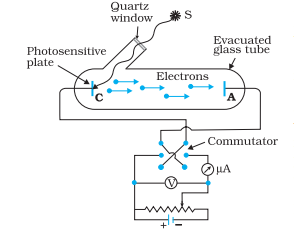
Figure for the question

The experimental set-up used for the photoelectric effect is shown. It consists of an evacuated glass/quartz tube having a thin photosensitive plate C and another metal plate A. Light from the source S of sufficiently short wavelength passes through the quartz window and falls on the photosensitive plate C (emitter). The electrons emitted by the plate C are collected by the plate A (collector) by the electric field created by the battery. The battery maintains the potential difference between the plates C and A, which can be varied. Thus, the plate A can be maintained at a desired positive or negative potential with respect to the emitter C. When the collector plate A is positive with respect to the emitter plate C, the electrons are attracted to it. The emission of electrons causes a flow of electric current in the circuit, called the photoelectric current.

The light from the source S that falls on the plate C in this set-up should be

Answer & explanation+

Correct answer: option 2

The correct answer is Option (2) → monochromatic (of a single frequency)

Each observation in this set-up is taken for a particular frequency of the incident radiation. This holds for the photocurrent, the saturation current and the stopping potential. The frequency is then changed to study its effect. So the light falling on C must have one known frequency at a time.

Option (1) of any colour — Incorrect. Light of a colour whose frequency is below the threshold frequency of the plate ejects no electrons at all. So the light must be of sufficiently short wavelength.

Option (2) monochromatic (of a single frequency) — Correct. With monochromatic light every photon has the same energy \( h\nu \). So a definite stopping potential \( V_0 \) can be measured for that frequency. The frequency can then be varied in a controlled way.

Option (3) white light — Incorrect. White light is a mixture of many frequencies. Photoelectrons ejected by the different frequencies have different maximum kinetic energies, so no single stopping potential belongs to a given frequency.

Option (4) infrared — Incorrect. Infrared radiation has a long wavelength and low photon energy, below the work function of the photosensitive plate. The set-up needs light of sufficiently short wavelength. The quartz window is there to let ultraviolet light through.

NCERT (2026-27):
Experimental Study of Photoelectric Effect – “… Monochromatic light from the source S of sufficiently short wavelength passes through the window W and falls on the photosensitive plate C (emitter). A transparent quartz window is sealed on to the glass tube, which permits ultraviolet radiation to pass through it and irradiate the photosensitive plate C.”

Advertisement

Practise more on Dual Nature of Radiation and Matter

Chapter-wise mocks on the real NTA exam screen, with solutions and your rank. Your first mocks are free.

Start free mocks →

Advertisement

Next questions

  1. निम्नलिखित में से शुद्ध वर्तनी के शब्द चुनिए -(A) निवृत्ति(B) परिस्थिति(C) दधीचि(D) परिक्षण(E) अन्ताक्षरीनीचे दिए गए विकल्पों में से सही उत…Hindi · व्याकरण - सशब्द शुद्धि
  2. Observe the image and answer the following question.Identify the painting in the image and its school.Fine Arts · The Deccani Schools of Painting
  3. Fill in the blanks given in List-I with the appropriate adverbs given in List-II.List-I (Sentences)List-II (Adverbs)(A) The parcel had glas…English · Grammar: Adverb
  4. In the figure given below, the three circles show the people of a club who like reading, music and travel; each number is the number of peo…General Aptitude Test · Verbal Reasoning
  5. Which of the following words is spelt correctly?English · Spelling Check
  6. Choose the sentences in which the preposition is used correctly:(A) The children are looking forward to the school trip to Jaipur.(B) The l…English · Grammar: Preposition
  7. Choose the correct statements about electric charge and electric field lines among the following.A. Coulomb’s law of electric force is vali…Physics · Electric Charges and Fields
  8. Urban population in India was _______ % of total population in 2011.Geography · India-People and Economy: Human Settlements
  9. A and B together can complete a work in 12 days. A alone can complete it in 20 days. If B does the work only for half a day daily, then in…General Aptitude Test · Numerical Ability
  10. A catalyst(A) increases the rate of reaction.(B) alters the equilibrium constant.(C) does not alter the Gibbs energy.(D) catalyses only spo…Chemistry · Physical: Chemical Kinetics