A catalyst
(A) increases the rate of reaction.
(B) alters the equilibrium constant.
(C) does not alter the Gibbs energy.
(D) catalyses only spontaneous reactions.
Choose the correct answer from the options given below:
Answer & explanation
Correct answer: option 2
The correct answer is Option (2) → (A), (C) and (D) only
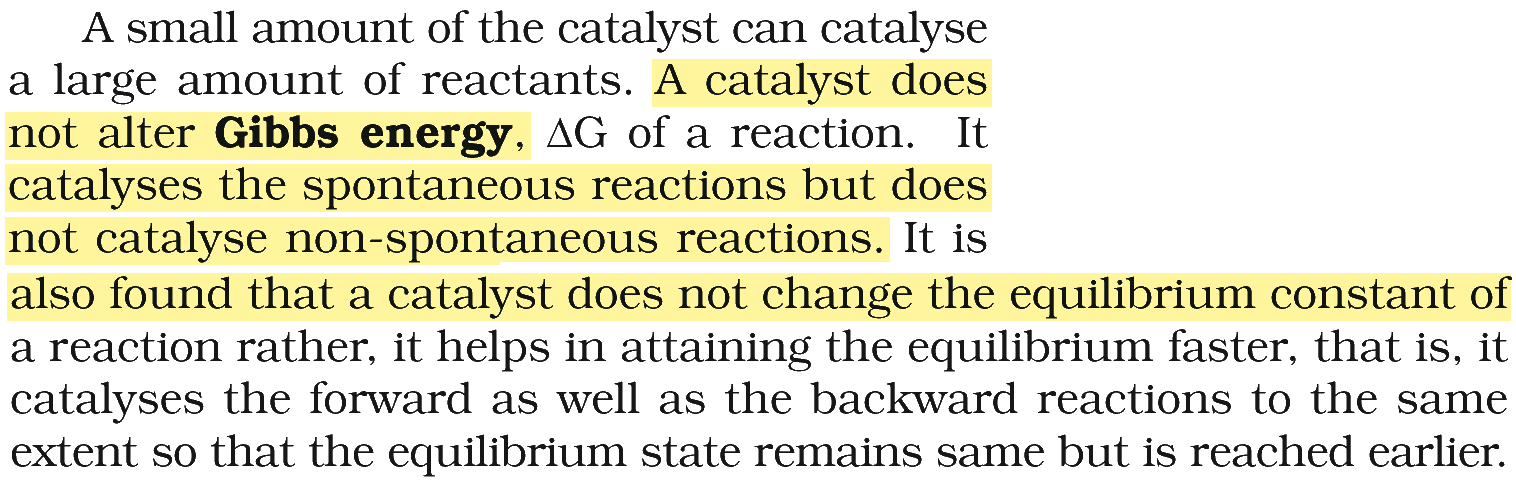
A catalyst increases the rate of a reaction without being consumed. It provides an alternative pathway with a lower activation energy, so more molecules have enough energy to react. It does not change the energies of the reactants and products themselves.
(A) increases the rate of reaction. — Correct. By lowering the activation energy, the catalyst increases the fraction of effective collisions and hence the rate.
(B) alters the equilibrium constant. — Incorrect. A catalyst speeds up the forward and the backward reactions to the same extent. Equilibrium is reached sooner, but the equilibrium constant stays the same.
(C) does not alter the Gibbs energy. — Correct. ΔG depends only on the initial and final states, which the catalyst does not change.
(D) catalyses only spontaneous reactions. — Correct. A catalyst cannot make a non-spontaneous reaction (ΔG positive) take place; it only speeds up reactions that are already feasible.
NCERT (2026-27 edition):
Effect of Catalyst – …