ELECTROCHEMICAL PROCESSES
The standard electrode potentials are very important and we can extract a lot of useful information from them. If the standard electrode potential of an electrode is greater than zero then its reduced form is more stable compared to hydrogen gas. Similarly, if the standard electrode potential is negative then hydrogen gas is more stable than the reduced form of the species. Electrochemical cells are extensively used for determining the pH of solutions, solubility product, equilibrium constant, thermodynamic properties and for potentiometric titrations. The potential of individual half-cell cannot be measured. We can measure only the difference between the two half-cell potentials that gives the emf of the cell. If we arbitrarily choose the potential of one electrode (half-cell) then that of the other can be determined with respect to this. According to convention, a half-cell called the Standard Hydrogen Electrode (SHE) is assigned a zero potential at all temperatures corresponding to the reaction \( \mathrm{H^{+}_{(aq)}+e^{-}\rightarrow \frac{1}{2}H_2(g)} \)
Consider the following reaction:
Cu(s) + 2Ag+(aq) → Cu2+(aq) + 2Ag(s)
The \( E^{0}_{cell} \) = 0.46 V.
The standard Gibbs energy change for this reaction is :
Answer & explanation
Correct answer: option 3
The correct answer is Option (3) → − 88780 J/mol
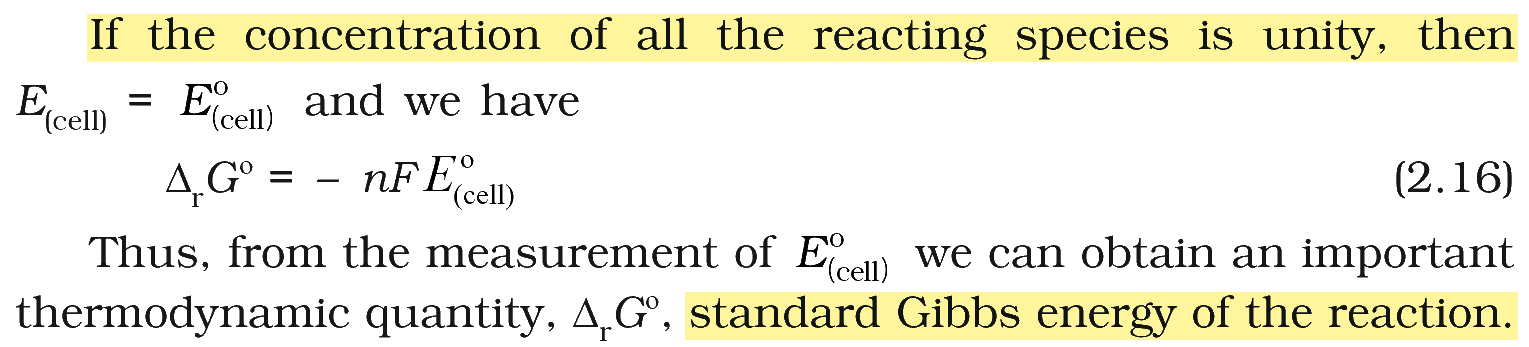
The standard Gibbs energy change of a cell reaction comes from its standard emf:
\( \displaystyle \Delta_rG^{\circ}=-nFE^{\circ}_{\text{cell}} \)
Here n is the number of electrons transferred in the balanced equation, and F = 96500 C mol−1. A positive E°cell gives a negative ΔrG°, so the reaction is spontaneous.
In Cu(s) + 2Ag+(aq) → Cu2+(aq) + 2Ag(s), the half-reactions are:
\( \displaystyle \ce{Cu -> Cu^2+ + 2e^-} \)
\( \displaystyle \ce{2Ag^+ + 2e^- -> 2Ag} \)
\( \displaystyle n=2 \)
\( \displaystyle \Delta_rG^{\circ}=-2\times96500\times0.46 \)
\( \displaystyle \Delta_rG^{\circ}=-88780\ \mathrm{J\,mol^{-1}}\ (=-88.78\ \mathrm{kJ\,mol^{-1}}) \)
Shortcut: E°cell is positive, so ΔrG° must be negative, which rules out Options (2) and (4). Also, 2 × 96500 × 0.46 is roughly 9 × 10⁴, so the answer cannot be −8.878.
NCERT (2026-27 edition):
Electrochemical Cell and Gibbs Energy of the Reaction – …