
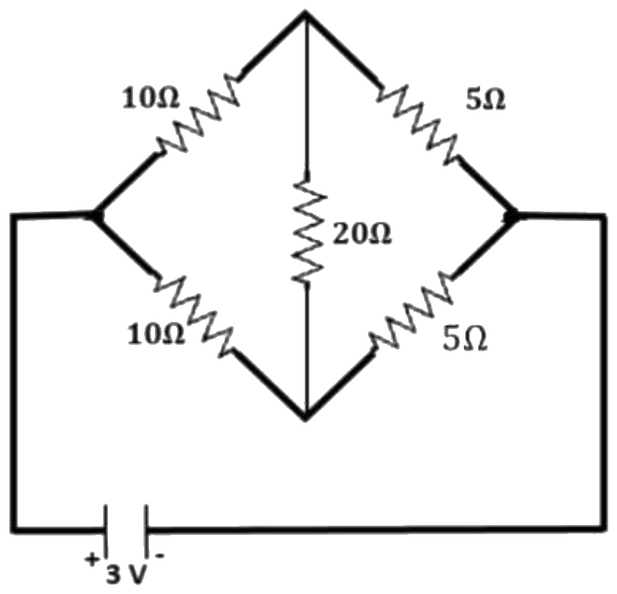
The current passing through \( 20\,\Omega \) resistance in the Wheatstone bridge circuit given below will be
Answer & explanation
Correct answer: option 4
The correct answer is Option (4) → \( 0\,\mathrm{A} \)
This is a Wheatstone bridge. It is balanced when the ratio of the resistances in the two arms on one side equals the ratio on the other side. Readings from the figure:
\( \text{upper arms: } 10\,\Omega \text{ and } 5\,\Omega \)
\( \text{lower arms: } 10\,\Omega \text{ and } 5\,\Omega \)
\( \displaystyle \frac{10\,\Omega}{5\,\Omega} = \frac{10\,\Omega}{5\,\Omega} \)
The balance condition holds, so the top and bottom junctions are at the same potential. With no potential difference across the \( 20\,\Omega \) resistor, the current through it is zero.