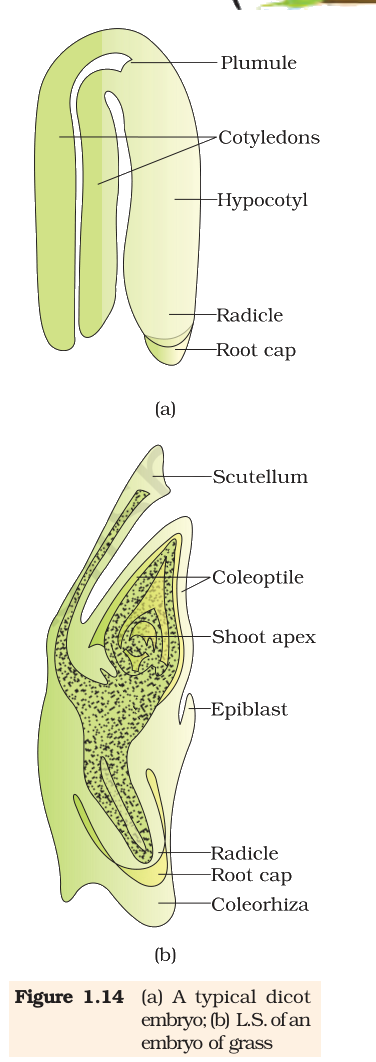
Cotyledon in the grass family is known as:
Answer & explanation
Correct answer: option 3
The correct answer is Option (3) → Scutellum
(1) Coleoptile — Incorrect. The coleoptile is the hollow sheath that covers the shoot apex of the grass embryo.
(2) Epiblast — Incorrect. The cotyledon of grasses is not called epiblast.
(3) Scutellum — Correct. A grass embryo has only one cotyledon. In the grass family this cotyledon is called the scutellum. It lies to one side (lateral) of the embryonal axis.
(4) Coleorhiza — Incorrect. The coleorhiza is the sheath that covers the radicle and root cap at the lower end of the embryonal axis.
Note: A similar question was also asked in CUET (UG) 2026 on 29-05-2026 (Slot 1) and on 22-05-2026 (Slot 2), and in CUET (UG) 2023 on 08-06-2023 (Slot 3), on 01-06-2023 (Slot 3) and on 28-05-2023 (Slot 1).
NCERT Extract:
Embryo – “… Embryos of monocotyledons (Figure 1.14 b) possess only one cotyledon. In the grass family the cotyledon is called scutellum that is situated towards one side (lateral) of the embryonal axis. At its lower end, the embryonal axis has the radical and root cap enclosed in an undifferentiated sheath called coleorrhiza. The portion of the embryonal axis above the level of attachment of scutellum is the epicotyl. Epicotyl has a shoot apex and a few leaf primordia enclosed in a hollow foliar structure, the coleoptile.”