In a factory manufacturing export quality shirts, it is determined that standard output per worker per day is 10 units and those who made standard or more than standard will get Rs. 50 per unit and those below will get Rs. 40 per unit. Now, an efficient worker making 11 units will get Rs. 550 per day whereas a worker who makes 9 units will get ________ per day.
Answer & explanation
Correct answer: option 2
The correct answer is Option (2) → Rupees 360
Under Taylor’s differential piece wage system, workers who reach the standard output are paid at a higher rate per unit, and those below the standard at a lower rate. The difference in pay is meant to push the inefficient worker to improve.
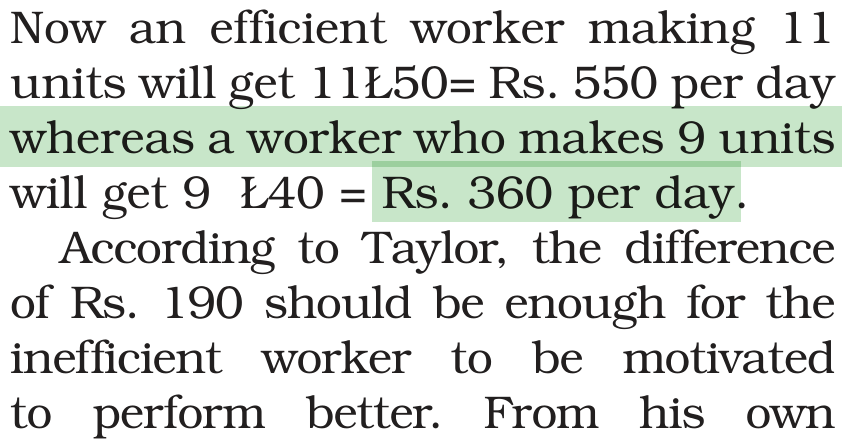
The worker makes 9 units, which is below the standard of 10 units, so the lower rate of Rs. 40 per unit applies:
Wage = units made × rate per unit
Wage = 9 × Rs. 40 = Rs. 360
Option (1) Rupees 450 — Incorrect. This is 9 × Rs. 50. The higher rate is paid only to those who reach the standard.
Option (2) Rupees 360 — Correct. As worked out above.
Option (3) Rupees 400 — Incorrect. This is 10 × Rs. 40, but the worker made 9 units, not 10.
Option (4) Rupees 500 — Incorrect. This is the pay for the standard output at the higher rate, 10 × Rs. 50.
NCERT (2026-27 Edition): “Differential Piece Wage System Taylor was a strong advocate of piece wage system. He wanted to differentiate between efficient and inefficient workers. The standard time and other parameters should be determined on the basis of the work-study discussed above. The workers can then be classified as efficient or inefficient on the basis of these standards. He wanted to reward efficient workers. So he introduced different rate of wage payment for those who performed above standard and for those who performed below standard. For example, it is determined that standard output per worker per day is 10 units and those who made standard or more than standard will get Rs. 50 per unit and those below will get Rs. 40 per unit. …”
|