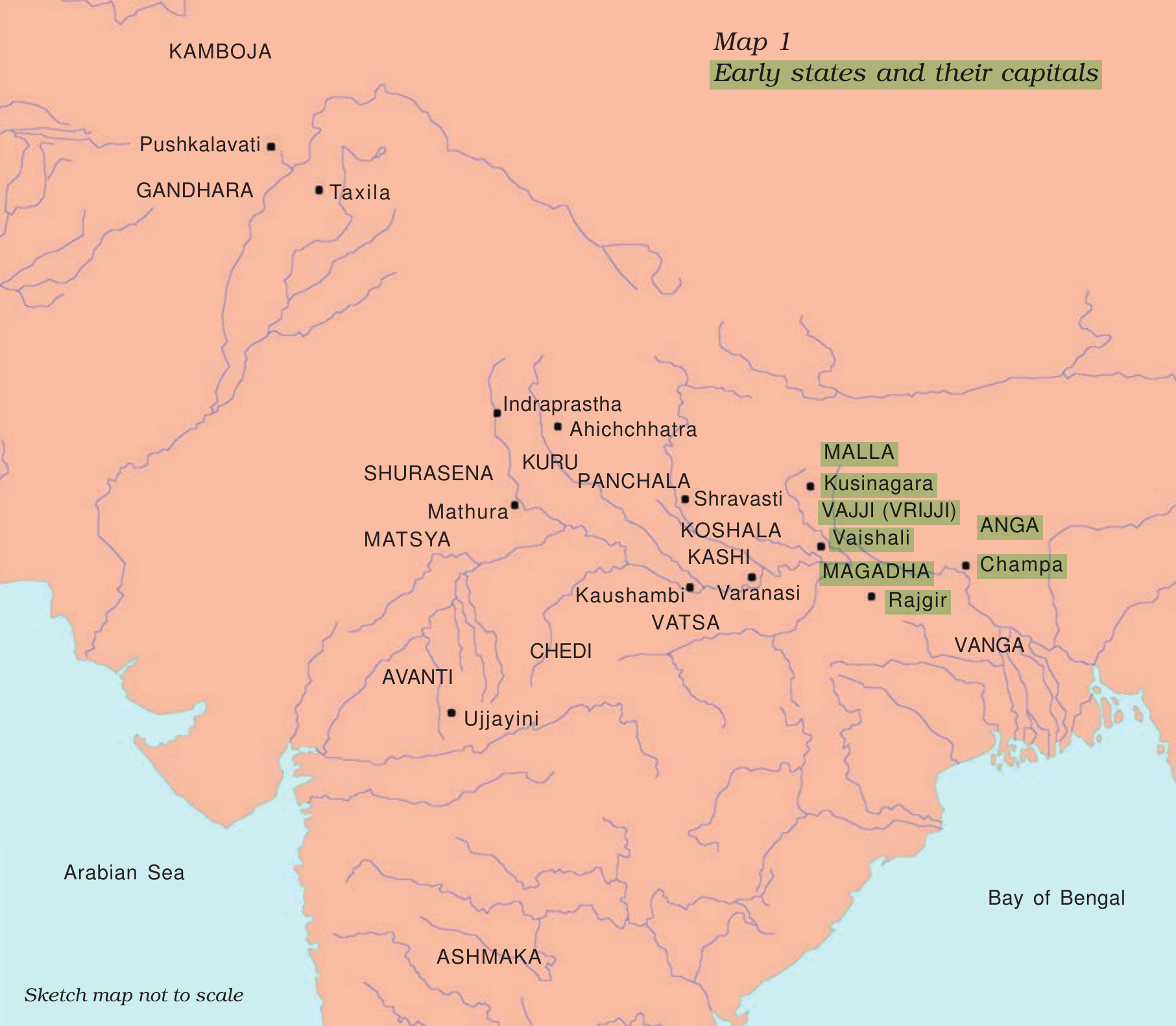
Match List-I with List-II:
| List-I Early States | List-II Capitals | ||
| (A) | Magadha | (I) | Champa |
| (B) | Anga | (II) | Vaishali |
| (C) | Malla | (III) | Rajgir |
| (D) | Vajji (Vrijji) | (IV) | Kusinagara |
Answer & explanation
Correct answer: option 2
The correct answer is Option (2) → (A)-(III), (B)-(I), (C)-(IV), (D)-(II)
(A) Magadha — this matches (III) Rajgir. Initially, Rajagaha, the Prakrit name for present-day Rajgir in Bihar, was the capital of Magadha; later, in the fourth century BCE, the capital was shifted to Pataliputra.
(B) Anga — this matches (I) Champa. On the map of early states and their capitals, Champa is marked in Anga, to the east of Magadha.
(C) Malla — this matches (IV) Kusinagara. The map marks Kusinagara in the Malla state.
(D) Vajji (Vrijji) — this matches (II) Vaishali. The map marks Vaishali in Vajji (Vrijji), just north of Magadha.
NCERT (2026-27): “2.2 First amongst the sixteen: Magadha … However, early Buddhist and Jaina writers who wrote about Magadha attributed its power to the policies of individuals: ruthlessly ambitious kings of whom Bimbisara, Ajatasattu and Mahapadma Nanda are the best known, and their ministers, who helped implement their policies. Initially, Rajagaha (the Prakrit name for present-day Rajgir in Bihar) was the capital of Magadha. Interestingly, the old name means ‘house of the king’. Rajagaha was a fortified settlement, located amongst hills. Later, in the fourth century BCE, the capital was shifted to Pataliputra, present-day Patna, commanding routes of communication along the Ganga.…”
|