In the following reaction, major products A & B are, respectively

Answer & explanation
Correct answer: option 1
The correct answer is Option (1) → A = Diethyl ether, B = Ethene
The compound shown is ethanol, \( \ce{CH3CH2OH} \). Heated with concentrated H2SO4, ethanol is dehydrated, and the temperature decides the product:
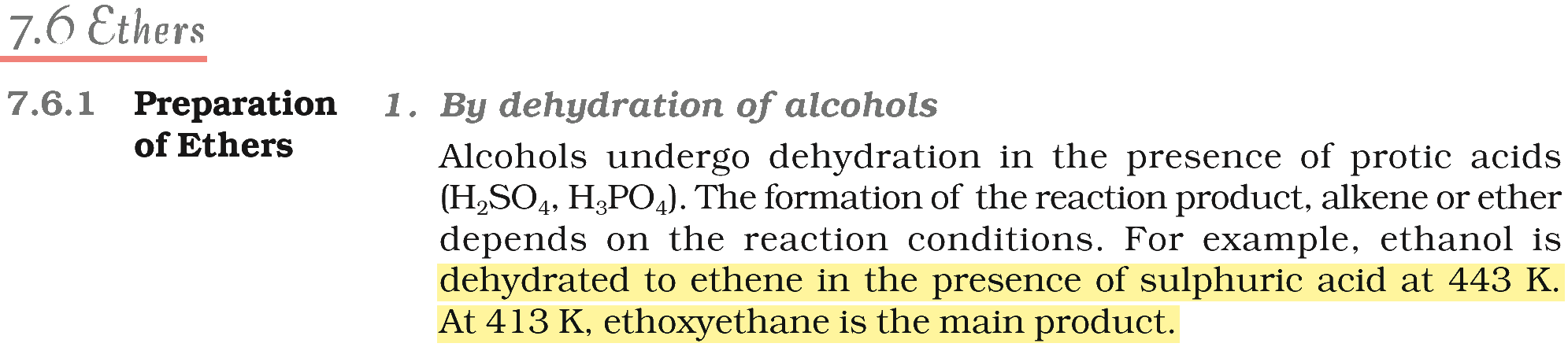
At 413 K (lower temperature, excess alcohol): two molecules of ethanol lose one molecule of water between them (intermolecular dehydration). The protonated alcohol is attacked by a second ethanol molecule (SN2), giving diethyl ether:
\( \displaystyle \ce{2C2H5OH} \xrightarrow[\text{413 K}]{\ce{H2SO4}} \ce{C2H5-O-C2H5 + H2O} \)
At 443 K (higher temperature): one molecule of ethanol loses water within itself (intramolecular dehydration, elimination), giving ethene:
\( \displaystyle \ce{C2H5OH} \xrightarrow[\text{443 K}]{\ce{H2SO4}} \ce{CH2=CH2 + H2O} \)
So A = diethyl ether and B = ethene.
Why the other options are incorrect
Option (2) A = Ethene, B = Diethyl ether — Incorrect. The products are swapped. Elimination is favoured at the higher temperature, so ethene forms at 443 K.
Option (3) A = Ethylmethyl ether, B = Ethene — Incorrect. Only ethanol is present, so both groups on the ether oxygen must be ethyl; a methyl group cannot appear.
Option (4) A = Acetylene, B = Diethyl ether — Incorrect. Loss of one water molecule gives a C=C bond, not a C≡C bond; acetylene cannot form by dehydration of ethanol.
NCERT (2026-27 edition):
By Dehydration of Alcohols