Calculate \( \Lambda_m^0 \) for acetic acid if \( \Lambda_m^0 \) for NaCl, HCl and CH3COONa are 126.5, 426.9 & 95.0 S cm2 mol−1, respectively.
Answer & explanation
Correct answer: option 2
The correct answer is Option (2) → 395 S cm2 mol−1
Kohlrausch’s law of independent migration of ions states that the limiting molar conductivity of an electrolyte is the sum of the limiting molar conductivities of its cation and anion:
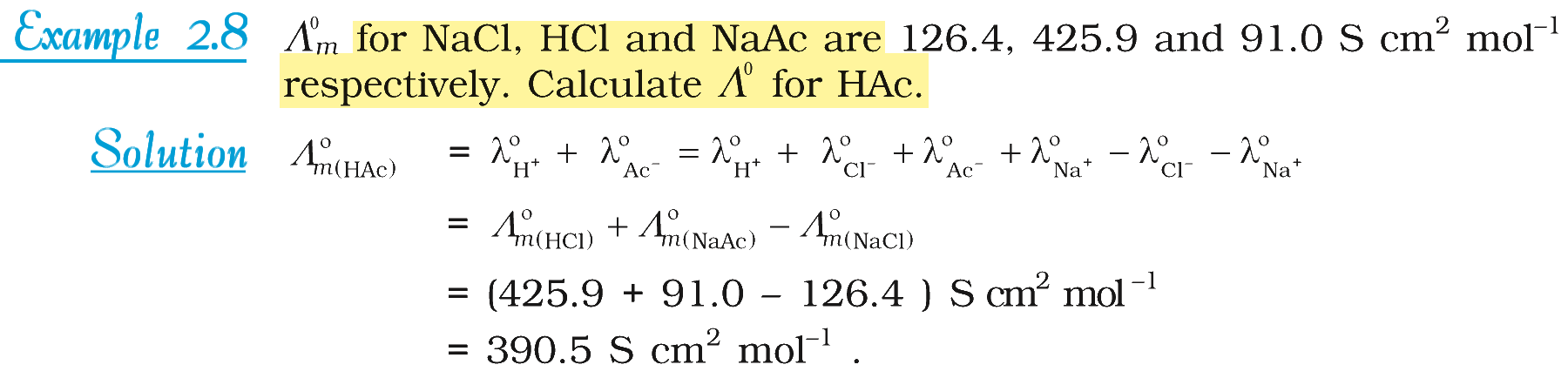
\( \displaystyle \Lambda_m^0(\ce{CH3COOH})=\lambda^0(\ce{H+})+\lambda^0(\ce{CH3COO-}) \)
For a weak electrolyte such as acetic acid, \( \Lambda_m^0 \) cannot be found by extrapolating the conductivity curve to zero concentration, because the curve rises steeply there. So it is obtained by combining strong electrolytes that supply the required ions and cancel the unwanted ones:
\( \displaystyle \Lambda_m^0(\ce{CH3COOH})=\Lambda_m^0(\ce{HCl})+\Lambda_m^0(\ce{CH3COONa})-\Lambda_m^0(\ce{NaCl}) \)
The right-hand side gives \( \ce{H^{+}} \) + \( \ce{Cl^{-}} \) + \( \ce{CH3COO^{-}} \) + \( \ce{Na^{+}} \) − \( \ce{Na^{+}} \) − \( \ce{Cl^{-}} \) = \( \ce{H^{+}} \) + \( \ce{CH3COO^{-}} \).
\( \displaystyle \Lambda_m^0(\ce{CH3COOH})=426.9+95.0-126.5 \)
\( \displaystyle \Lambda_m^0(\ce{CH3COOH})=395.4\approx395\ \mathrm{S\,cm^2\,mol^{-1}} \)
Note: NTA picked this question from an NCERT (2026-27) example and changed the figures. Do not ignore NCERT while practising numericals.
NCERT (2026-27 edition):
Variation of Conductivity and Molar Conductivity with Concentration – …