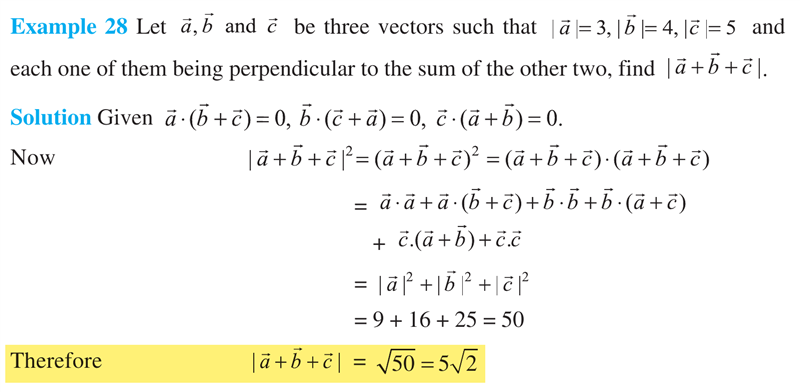
Let \(\vec{a}, \vec{b}\) and \(\vec{c}\) be three vectors such that \(|\vec{a}|=2\), \(|\vec{b}|=3\), \(|\vec{c}|=5\) and each one of three vectors is perpendicular to the sum of the other two, then value of \(|\vec{a}+\vec{b}+\vec{c}|\) is :
Answer & explanation
Correct answer: option 2
The correct answer is Option (2) → \(\sqrt{38}\)
Perpendicular vectors have dot product zero:
\(\vec{a}\cdot(\vec{b}+\vec{c})=0,\ \text{so}\ \vec{a}\cdot\vec{b}+\vec{a}\cdot\vec{c}=0\)
\(\vec{b}\cdot(\vec{c}+\vec{a})=0,\ \text{so}\ \vec{b}\cdot\vec{c}+\vec{b}\cdot\vec{a}=0\)
\(\vec{c}\cdot(\vec{a}+\vec{b})=0,\ \text{so}\ \vec{c}\cdot\vec{a}+\vec{c}\cdot\vec{b}=0\)
Adding the three:
\(2\left(\vec{a}\cdot\vec{b}+\vec{b}\cdot\vec{c}+\vec{c}\cdot\vec{a}\right)=0\)
Now expand the square of the magnitude:
\(|\vec{a}+\vec{b}+\vec{c}|^2=|\vec{a}|^2+|\vec{b}|^2+|\vec{c}|^2+2\left(\vec{a}\cdot\vec{b}+\vec{b}\cdot\vec{c}+\vec{c}\cdot\vec{a}\right)\)
\(=4+9+25+0=38\)
\(|\vec{a}+\vec{b}+\vec{c}|=\sqrt{38}\)
NCERT (2026-27 edition):
Vector Algebra