CUETMOCK
  • Pricing
  • Mentors
Log inStart freeStart free mocks→

First test, then trust

Try a free CUET mock test.

Join 5,00,000+ students who rehearsed exam day on the exact NTA screen before sitting CUET. On the web and on Android.

Start free mocks →Get the Android app
CUETMOCK

India's #1 CUET Mock Test Platform. Original NCERT-based questions on the exact NTA exam screen — trusted by 5,00,000+ students since CUET 2022.

Get it onGoogle PlayScan to download the CUETMOCK app

Mock tests

  • CUET mock test series
  • Browse all papers
  • Commerce mocks
  • Humanities (Arts) mocks
  • Science mocks
  • Languages & GAT mocks
  • Free practice questions
  • Pricing

Resources

  • CUET exam guide
  • CUET syllabus
  • Universities accepting CUET
  • Expert blogs
  • News & notifications
  • Webinars & counselling
  • CUET score calculator
  • How we estimate your rank
  • FAQs

Company

  • About us
  • Our leadership & team
  • Our toppers
  • Mentors
  • For schools
  • Contact us
  • Terms
  • Privacy
  • Refund policy

Talk to us

+91 7696 6630 56info@cuetmock.comWhatsApp us

Our other platforms

  • JEE Mock — For IIT-JEE aspirants
  • NEET Mock — For NEET aspirants

Newsletter

Exam updates, study material and offers — no spam.

© 2026 NYC Ventures Pvt. Ltd.

701-702, Royal Business Park, Zirakpur, Punjab - 140603

  • Terms of use
  • Privacy policy
  • Refund policy
  • Contact us

iCUETMOCK is an independent preparation platform, not affiliated with the National Testing Agency (NTA). Always check exam details on the official NTA website.

  • Home
  • Mock tests
  • CUET guide
  • Pricing
  • Log in
Home/Practice questions/History
HistoryMedieval India: Bhakti Sufi Traditions

Arrange the following religious teachers in the Indian subcontinent i…

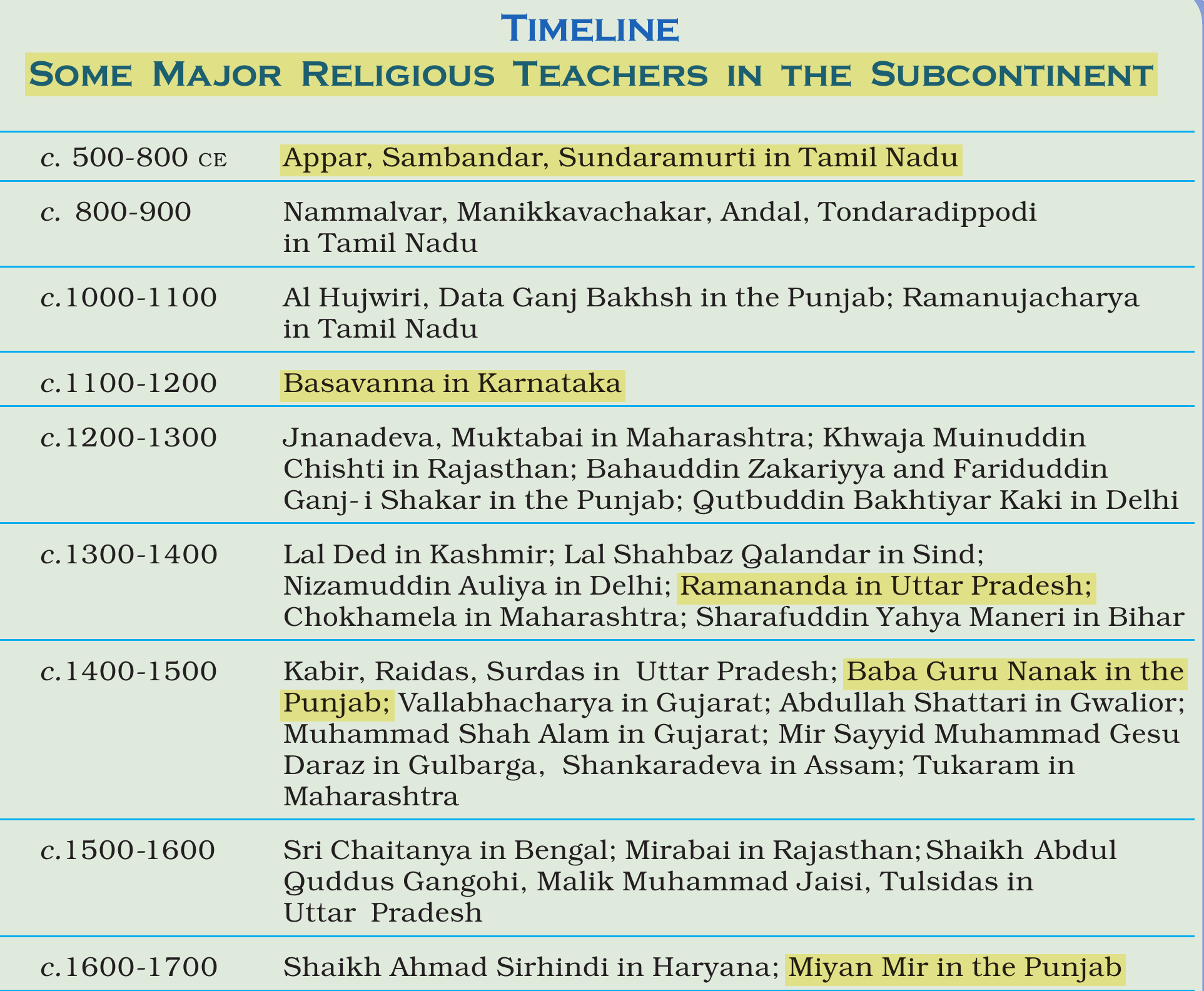
Arrange the following religious teachers in the Indian subcontinent in a chronological manner.

(A) Miyan Mir in the Punjab
(B) Basavanna in Karnataka
(C) Sundaramurti in Tamil Nadu
(D) Guru Nanak in the Punjab
(E) Ramananda in Uttar Pradesh

Choose the correct answer from the options given below:

Answer & explanation+

Correct answer: option 3

The correct answer is Option (3) → (C), (B), (E), (D), (A)

(C) Sundaramurti in Tamil Nadu — c. 500-800 CE, with Appar and Sambandar; the earliest of the five.

(B) Basavanna in Karnataka — c. 1100-1200.

(E) Ramananda in Uttar Pradesh — c. 1300-1400.

(D) Guru Nanak in the Punjab — c. 1400-1500.

(A) Miyan Mir in the Punjab — c. 1600-1700, the latest of the five.


NCERT: Themes in Indian History Part II — Chapter 6: Bhakti-Sufi Traditions (2026-27)

NCERT extract

Advertisement

Practise more on Medieval India: Bhakti Sufi Traditions

Chapter-wise mocks on the real NTA exam screen, with solutions and your rank. Your first mocks are free.

Start free mocks →

Advertisement

Next questions

  1. Fayol says that discipline requires: (A) Good supervisors at all levels (B) Agreements should be clear and fair (C) Removal of the employee…Business Studies · Principles of Management
  2. Identify the kind of Adverb used in the following sentence: She seldom visits her parents.English · Grammar: Adverb
  3. Pandit Kishan Maharaj was a famous Indian ______ player.General Aptitude Test · General Knowledge
  4. The average score of a cricket team (of ten players and one captain) is 32. The scores of ten players are: 22, 11, 5, 34, 21, 32, 0, 28, 9…General Aptitude Test · Numerical Ability
  5. Consider the following statements:I. The sum of any two odd numbers is always odd.II. The product of any three consecutive natural numbers…General Aptitude Test · Numerical Ability
  6. Current projections of global warming at 3°C above pre-industrial levels suggest that the human race ______.English · Comprehension - (Narrative / Factual)
  7. Let f(x)=tan ^-1(g(x)), where g(x) is monotonically increasing for 0<x<(π)/2. Then, f(x), isMaths. Section B1 · Applications of Derivatives
  8. In the ground state of a hydrogen atom, the electron moves in an orbit of radius 5.3×10^-11\ m with a speed of 2.2×10^6\ mathrmm s^-1 . The…Physics · Atoms
  9. During the colonial period, what share of India’s workforce was in the manufacturing sector?Economics · Indian Economic Development: Indian Economy on the Eve of Independence
  10. If the supply curve is p=√(9+x) and the quantity sold in market is 7 units, then the producer's surplus will beApplied Maths. Section B2 · Calculus