
Which of the following statements about insulin is incorrect?
Answer & explanation
Correct answer: option 4
The correct answer is Option (4) → Mature insulin contains the C-peptide.
Insulin is a hormone made of two short polypeptide chains, chain A and chain B, joined by disulphide bridges. In the body it is first made as a larger pro-hormone (pro-insulin). Pro-insulin has an extra piece, the C peptide. During maturation the C peptide is cut out, and only chains A and B stay joined. So mature insulin has no C peptide.
Option (1) Insulin consists of two short polypeptide chains, chain A and chain B. — A correct statement. Chain A and chain B are the two chains that stay in mature insulin after the C peptide is cut out.
Option (2) The two polypeptide chains of insulin are linked together by disulphide bridges. — A correct statement. Disulphide bridges (S–S bonds) hold the two chains together.
Option (3) In mammals, including humans, insulin is synthesised as a pro-hormone containing an extra stretch called the C-peptide. — A correct statement. The pro-hormone has an extra stretch, the C peptide, which must be removed before the hormone works.
Option (4) Mature insulin contains the C-peptide. — The incorrect statement. The C peptide is removed during maturation and is not present in mature insulin.
NCERT Extract:
Genetically Engineered Insulin – “… Insulin consists of two short polypeptide chains: chain A and chain B, that are linked together by disulphide bridges (Figure 10.3). … In mammals, including humans, insulin is synthesised as a pro-hormone (like a pro-enzyme, the pro-hormone also needs to be processed before it becomes a fully mature and functional hormone) which contains an extra stretch called the C peptide. This C peptide is not present in the mature insulin and is removed during maturation into insulin.”
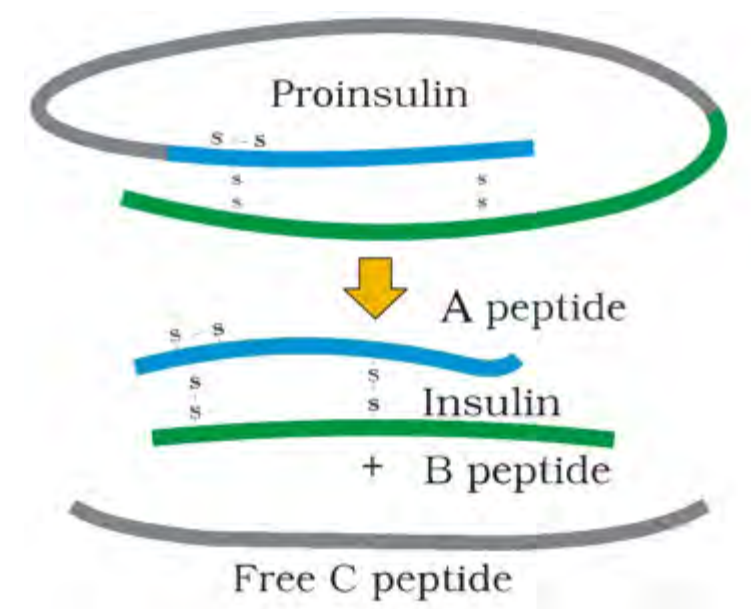
Figure 10.3 Maturation of pro-insulin into insulin (simplified)