The value of an item costing Rs. \( x \) depreciates in such a way that after 6 years the value is just a quarter of original value . The annual depreciation is:
Answer & explanation
Correct answer: option 3
The correct answer is Option (3) → Rs. \( \displaystyle\frac{x}{8} \)
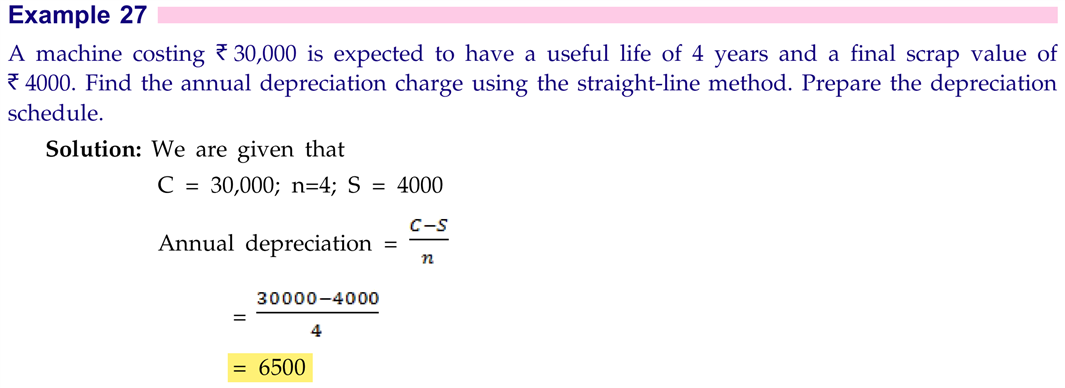
The depreciation is taken as a fixed amount each year (the linear, or straight line, method):
\( \displaystyle \text{Annual depreciation}=\frac{\text{Original cost}-\text{Value after n years}}{n} \)
The value after 6 years is \( \frac{x}{4} \), so
\( \displaystyle \text{Annual depreciation}=\frac{x-\frac{x}{4}}{6} \)
\( \displaystyle =\frac{\frac{3x}{4}}{6} \)
\( \displaystyle =\frac{x}{8} \)
So the annual depreciation is Rs. \( \frac{x}{8} \).
Why the other options are incorrect
Option (1) Rs. \( \displaystyle\frac{x}{2} \) — Incorrect. A depreciation of \( \frac{x}{2} \) a year would bring the value to 0 in only 2 years.
Option (2) Rs. \( \displaystyle\frac{x}{4} \) — Incorrect. \( \frac{x}{4} \) is the value left after 6 years, not the yearly depreciation.
Option (4) Rs. \( \displaystyle\frac{x}{12} \) — Incorrect. Six years at \( \frac{x}{12} \) a year remove only \( \frac{x}{2} \), leaving half the cost, not a quarter.
CBSE Applied Mathematics (Class XII):
Depreciation