
Read the passage and answer the following five questions.
Demographic transition theory can be used to describe and predict the future population of any area. The theory tells us that population of any region changes from high births and high deaths to low births and low deaths as society progresses from rural agrarian and illiterate to urban industrial and literate society. These changes occur in stages which are collectively known as the demographic cycle.
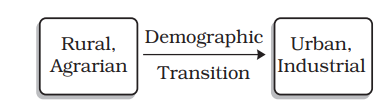
The above figure explains the three-staged model of Demographic Transition Theory: The first stage has high fertility and high mortality because people reproduce more to compensate for the deaths due to epidemics and variable food supply. The population growth is slow and most of the people are engaged in agriculture where large families are an asset. Life expectancy is low, people are mostly illiterate and have low levels of technology. Two hundred years ago all the countries of the world were in this stage. Fertility remains high in the beginning of second stage but it declines with time. This is accompanied by reduced mortality rate. Improvements in sanitation and health conditions lead to decline in mortality. Because of this gap the net addition to population is high. In the last stage, both fertility and mortality decline considerably. The population is either stable or grows slowly. The population becomes urbanised, literate and has high technical know-how and deliberately controls the family size. This shows that human beings are extremely flexible and are able to adjust their fertility. In the present day, different countries are at different stages of demographic transition.
Which of the following does not happen in the second stage?
Answer & explanation
Correct answer: option 4
The correct answer is Option (4) → High death rate
The passage states: “Fertility remains high in the beginning of second stage but it declines with time. This is accompanied by reduced mortality rate. Improvements in sanitation and health conditions lead to decline in mortality.”
Option (1) Decline in mortality — Happens in the second stage. Better sanitation and health conditions bring the death rate down in this stage.
Option (2) Fertility remains high in the beginning — Happens in the second stage. Births stay high at first and fall only with time.
Option (3) Low death rate — Happens in the second stage. With reduced mortality, the death rate falls while births are still high. This gap makes the net addition to population high.
Option (4) High death rate — Does not happen in the second stage. A high death rate belongs to the first stage, which has high fertility and high mortality.