
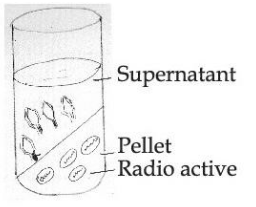
A students was repeating the experiments of Alfred Hershey and Martha Chase (1952). Results obtained by him are shown in the given figure. Select the biomolecule that was radio actively labelled by the students for his experiment.
Answer & explanation
Correct answer: option 1
The correct answer is Option (1) → DNA of bacteriophage with radio active Phosphorous
After infection, the tube is spun in a centrifuge. The heavy bacteria settle as the pellet; the light virus coats stay in the supernatant. In the figure the pellet is radioactive, so the label went inside the bacteria. Only the phage’s genetic material enters the bacterium.
Option (1) DNA of bacteriophage with radio active Phosphorous — Correct. DNA contains phosphorus but protein does not. Phages grown on 32P have radioactive DNA, which enters the bacteria and makes the pellet radioactive.
Option (2) Plasmid DNA of E. coli with radio active Sulphur — Incorrect. DNA has no sulphur, so it cannot be labelled with it. Also, the experiment labels the virus, not the bacterium.
Option (3) Proteins of bacteriophage with radio active Sulphur — Incorrect. Protein coats labelled with 35S stay outside the bacteria. They are knocked off in the blender, so the supernatant, not the pellet, would be radioactive.
Option (4) Chromosomal DNA of E. coli with radio active Sulphur — Incorrect. Again, DNA contains no sulphur, and the bacteria are not the labelled partner.
NCERT Extract:
The Genetic Material Is DNA – “… The unequivocal proof that DNA is the genetic material came from the experiments of Alfred Hershey and Martha Chase (1952). They worked with viruses that infect bacteria called bacteriophages. The bacteriophage attaches to the bacteria and its genetic material then enters the bacterial cell. The bacterial cell treats the viral genetic material as if it was its own and subsequently manufactures more virus particles. Hershey and Chase worked to discover whether it was protein or DNA from the viruses that entered the bacteria. They grew some viruses on a medium that contained radioactive phosphorus and some others on medium that contained radioactive sulfur. Viruses grown in the presence of radioactive phosphorus contained radioactive DNA but not radioactive protein because DNA contains phosphorus but protein does not. Similarly, viruses grown on radioactive sulfur contained radioactive protein but not radioactive DNA because DNA does not contain sulfur. Radioactive phages were allowed to attach to E. coli bacteria. Then, as the infection proceeded, the viral coats were removed from the bacteria by agitating them in a blender. The virus particles were separated from the bacteria by spinning them in a centrifuge. Bacteria which was infected with viruses that had radioactive DNA were radioactive, indicating that DNA was the material that passed from the virus to the bacteria.”