Match list I with list II
| List I (Transition Metals) | List II (Maximum Oxidation State) |
| A. Ti | I. 7 |
| B. V | II. 4 |
| C. Mn | III. 5 |
| D. Cu | IV. 2 |
Choose the correct answer from the options given below:
Answer & explanation
Correct answer: option 1
The correct answer is Option (1) → A-II, B-III, C-I, D-IV
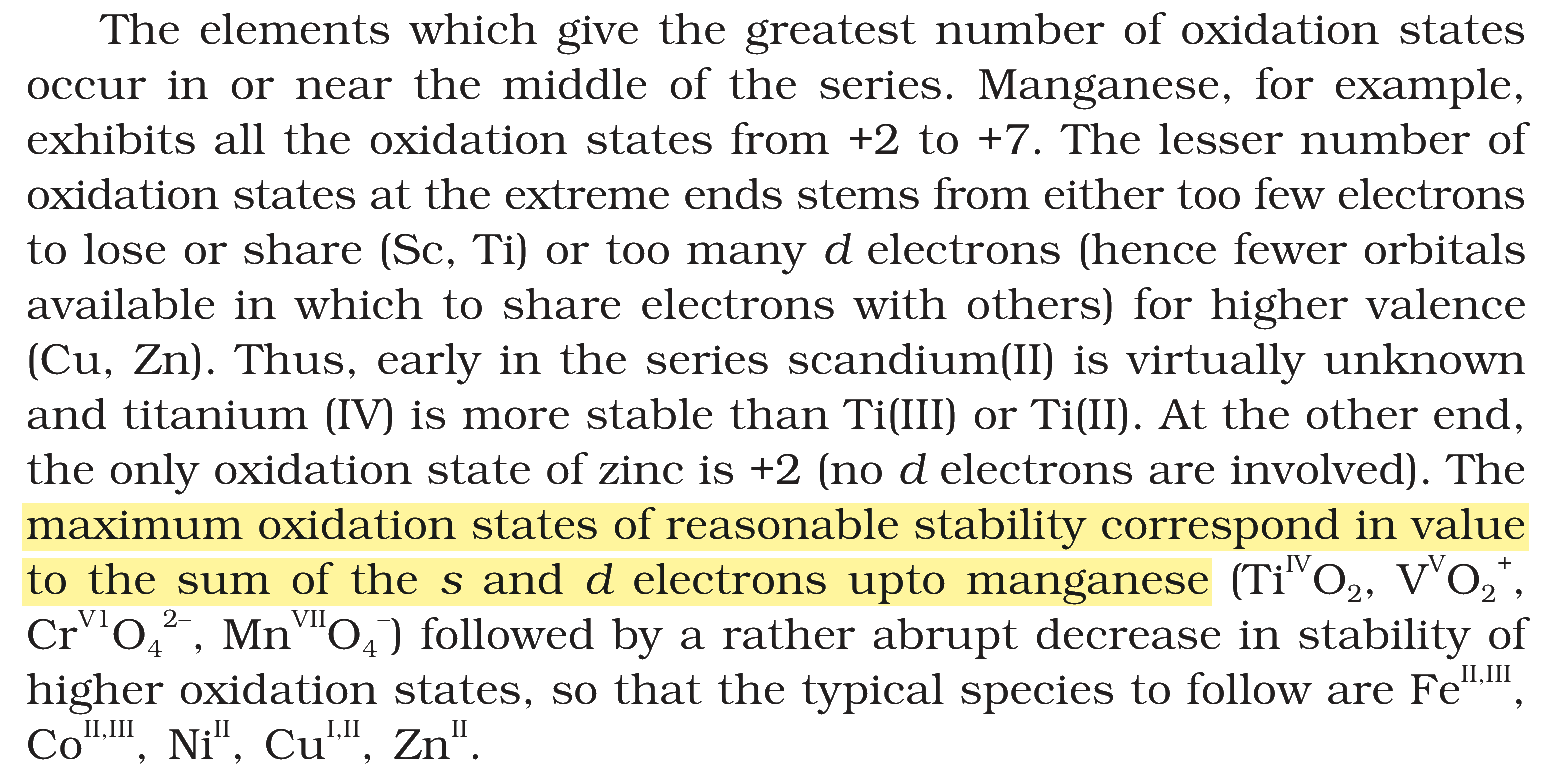
In the first transition series the highest oxidation state up to manganese equals the total number of 3d and 4s electrons, since all of them can take part in bonding. After manganese the number of unpaired d electrons falls and the highest states become lower.
A. Ti (3d24s2) — This matches II. 4. All four electrons are lost in Ti(IV), e.g. \( \ce{TiO2} \), \( \ce{TiCl4} \).
B. V (3d34s2) — This matches III. 5. All five electrons are used in V(V), e.g. \( \ce{V2O5} \).
C. Mn (3d54s2) — This matches I. 7. All seven electrons are used in Mn(VII), e.g. \( \ce{KMnO4} \), \( \ce{Mn2O7} \).
D. Cu (3d104s1) — This matches IV. 2. Copper shows +1 and +2; +2 (e.g. CuO, \( \ce{CuSO4} \)) is the highest common state.
NCERT (2026-27 edition):
Oxidation States – …