


CUET Preparation Today
A company uses three machines to manufacture two types of shirts, half sleeves and full sleeves. The number of hours required per week on machine $M_1, M_2$ and $M_3$ for one shirt of each type is given in the following table:
None of the machines can be in operation for more than 40 hours per week. The profit on each half sleeve shirt is ₹1 and the profit on each full sleeve shirt is ₹1.50. How many of each type of shirts should be made per week to maximise the company's profit? |
Produce 20 half sleeve shirts and 10 full sleeve shirts. Produce 10 half sleeve shirts and 15 full sleeve shirts. Produce 0 half sleeve shirts and 40 full sleeve shirts. Produce 40 half sleeve shirts and 0 full sleeve shirts. |
Produce 10 half sleeve shirts and 15 full sleeve shirts. |
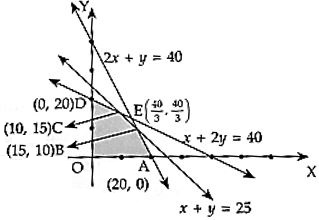
The correct answer is Option (2) → Produce 10 half sleeve shirts and 15 full sleeve shirts. Let x and y be the number of shirts of half sleeves and full sleeves respectively, then the problem can be formulated as an L.P.P. as follows: Maximize the profit (in ₹) $P=x+1.5y$ subject to the constraints $x+2y≤40$ (machine $M_1$ constraint) $2x+y≤40$ (machine $M_2$ constraint) $\frac{8}{5}x+\frac{8}{5}y≤40$ i.e. $x + y ≤ 25$ (machine $M_3$ constraint) $x ≥ 0, y ≥ 0$ (non-negativity constraints)
Draw the lines $x + 2y = 40$ ...(i) $2x + y = 40$ ...(ii) and $x + y = 25$ .....(iii) The points of intersection of lines (i) and (ii); (ii) and (iii), (iii) and (i) are $E(\frac{40}{3},\frac{40}{3})$, B(15, 10), C(10, 15) respectively. Shade the region bounded by the given inequalities. The shaded portion shows the feasible region, which is bounded. The corner points of the feasible region OABCD are O(0, 0), A(20, 0), B(15, 10), C(10, 15) and D(0, 20). At $O(0, 0), P = 0$. At $A(20, 0), P = 20 +0 × 1.5=20$ At $B(15, 10), P = 15+ 10 × 1.5 = 30$ At $C(10, 15), P = 10 + 15 × 1.5 = 32.5$ At $D(0, 20), P=0+20 × 1.5= 30$. We find that P is maximum at C(10, 15) and maximum value of P is 32.5. Hence, the company gets a maximum profit of 32.5 when 10 half sleeve shirts and 15 full sleeve shirts are made week. |