CUET Preparation Today
Answer the question on basis of passage given below: The noble gases \(He\) to \(Rn\) have close shell configuration and are monoatomic gases under normal conditions. Though mostly unreactive, but direct reaction of Xe with \(F_2\) leads to a series of compounds with Xe oxidation numbers +2, +4 and +6. When certain compounds like phenol and quinol are crystallised in the presence of noble gas such as Ar, Kr and Xe a category of compound called clathrates are formed. In these the noble gas atoms are trapped in the cavities of the crystal lattices. The compounds which crystallise are known as hosts (H) while the noble gas atoms are called guests (G). The general formula of a clathrate compound is nHmG, where n is the number of host molecules and m is the number of atoms a molecule of guest. |
Match List I with List II
Choose the correct answer from the options given below |
A-I, B-II, C-III, D-IV A-II, B-III, C-IV, D-I A-III, B-II, C-I, D-IV A-III, B-I, C-II, D-IV |
A-III, B-I, C-II, D-IV |
The correct answer is option 4. A-III, B-I, C-II, D-IV.
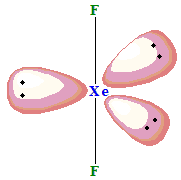
Let us go through each xenon compound from List I and use VSEPR (Valence Shell Electron Pair Repulsion) theory to explain the geometry and the shape in detail. A. \( \text{XeF}_2 \) (Xenon Difluoride): Electronic Configuration of Xenon: \( [Kr]4d^{10}5s^25p^6 \) Xenon is in group 18 and has 8 valence electrons. In \( \text{XeF}_2 \), xenon forms two bonds with fluorine atoms, using 2 of its valence electrons. This leaves 6 electrons or 3 lone pairs on xenon. The molecule has 5 electron pairs (2 bonding pairs + 3 lone pairs) around xenon. According to VSEPR theory, these 5 pairs adopt a trigonal bipyramidal arrangement to minimize repulsion. The 3 lone pairs occupy the equatorial positions, leaving the 2 fluorine atoms in the axial positions. This arrangement leads to a linear geometry for the molecule. Shape: Linear (III)
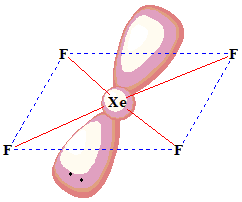
B. \( \text{XeF}_4 \) (Xenon Tetrafluoride): Xenon forms 4 bonds with fluorine atoms, using 4 of its 8 valence electrons. This leaves 4 electrons or 2 lone pairs on xenon. The molecule has 6 electron pairs (4 bonding pairs + 2 lone pairs). According to VSEPR theory, these 6 pairs adopt an octahedral arrangement. The 2 lone pairs take positions opposite to each other (180° apart) to minimize repulsion, while the 4 fluorine atoms occupy the positions in a plane (equatorial positions). This results in a square planar geometry. Shape: Square planar (I)
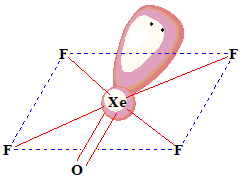
C. \( \text{XeOF}_4 \) (Xenon Oxytetrafluoride): Xenon is bonded to 1 oxygen atom and 4 fluorine atoms. Oxygen forms a double bond, while fluorine forms single bonds. Xenon uses 5 of its 8 valence electrons to form bonds, leaving 3 electrons (or 1 lone pair) on xenon. The molecule has 6 electron pairs (5 bonding pairs + 1 lone pair). These 6 pairs adopt an octahedral arrangement, but the lone pair distorts the symmetry. The lone pair occupies one position, and the 5 bonds (1 with oxygen and 4 with fluorine) form a square pyramidal geometry. Shape: Square pyramidal (II)
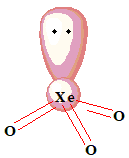
D. \( \text{XeO}_3 \) (Xenon Trioxide): Xenon forms 3 bonds with oxygen atoms, leaving 2 electrons (or 1 lone pair) on xenon. The molecule has 4 electron pairs (3 bonding pairs + 1 lone pair). These 4 pairs adopt a tetrahedral arrangement according to VSEPR theory. The lone pair distorts the geometry, resulting in a pyramidal shape. Shape: Pyramidal (IV)
Thus, the correct option is 4: A-III, B-I, C-II, D-IV |