
CUETMOCK
  • Pricing
  • Mentors
Log inStart freeStart free mocks→

First test, then trust

Try a free CUET mock test.

Join 5,00,000+ students who rehearsed exam day on the exact NTA screen before sitting CUET. On the web and on Android.

Start free mocks →Get the Android app
CUETMOCK

India's #1 CUET Mock Test Platform. Original NCERT-based questions on the exact NTA exam screen — trusted by 5,00,000+ students since CUET 2022.

Get it onGoogle PlayScan to download the CUETMOCK app

Mock tests

  • CUET mock test series
  • Browse all papers
  • Commerce mocks
  • Humanities (Arts) mocks
  • Science mocks
  • Languages & GAT mocks
  • Free practice questions
  • Pricing

Resources

  • CUET exam guide
  • CUET syllabus
  • Universities accepting CUET
  • Expert blogs
  • News & notifications
  • Webinars & counselling
  • CUET score calculator
  • How we estimate your rank
  • FAQs

Company

  • About us
  • Our leadership & team
  • Our toppers
  • Mentors
  • For schools
  • Contact us
  • Terms
  • Privacy
  • Refund policy

Talk to us

+91 7696 6630 56info@cuetmock.comWhatsApp us

Our other platforms

  • JEE Mock — For IIT-JEE aspirants
  • NEET Mock — For NEET aspirants

Newsletter

Exam updates, study material and offers — no spam.

© 2026 NYC Ventures Pvt. Ltd.

701-702, Royal Business Park, Zirakpur, Punjab - 140603

  • Terms of use
  • Privacy policy
  • Refund policy
  • Contact us

iCUETMOCK is an independent preparation platform, not affiliated with the National Testing Agency (NTA). Always check exam details on the official NTA website.

  • Home
  • Mock tests
  • CUET guide
  • Pricing
  • Log in
Home/Practice questions/General Aptitude Test
General Aptitude TestVerbal ReasoningDice

Three different positions of the same dice are shown. Find the number…

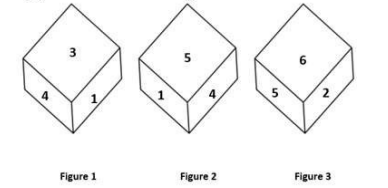
Three different positions of the same dice are shown. Find the number on the face opposite the face showing '5'.
 

Answer & explanation+

Correct answer: option 2

Step 1) In figure IInd  and IIIrd  5  is common

Step 2) The number ‘5’ is common in both the dice, but it is at a different position. In order to find out, the number appearing on the opposite face, rotate the dice in a clockwise direction with the common number as the reference.

Step 3)  5     4     1

              5     6      2

Step 4)   4  is opposite to 6

               1 is  opposite  to 2

therefore ,

              5  will  be  opposite  to 3


Short trick :

Compare figure Ist and IInd  4  and 1  both  are common

therefore

                 3  will be opposite to 5

Advertisement

Practise more on Verbal Reasoning

Chapter-wise mocks on the real NTA exam screen, with solutions and your rank. Your first mocks are free.

Start free mocks →

Advertisement

Next questions

  1. Which of the following sentences use the articles correctly?(A) A Mr Mehta rang up this morning and asked for your father.(B) The closer we…English · Grammar: Articles
  2. Select the most appropriate ANTONYM of the given word. PragmaticEnglish · Antonyms
  3. Match the following personalities in List 1 with the description in List 2 List- 1(Personalities) List- 2(Description) (A) Rajiv Gandhi (I)…Political Science · Politics in India Since Independence: Recent Developments in Indian Politics
  4. Match List-I with List-II List-I Four Ps of marketing List-II Explanation (A) Place (I) It includes activities that communicate the availab…Business Studies · Marketing
  5. Stanley Cohen and Herbert Boyer constructed the first recombinant DNA by isolating the antibiotic resistance gene by cutting out a piece of…Biology · Biotechnology -Principles and Processes
  6. Identify the timeline of the ‘First World War’:History · Modern India: Mahatma Gandhi and the Nationalist movement
  7. NastyEnglish · Antonyms
  8. If secA = 5/3, then what is the value of cot A ?General Aptitude Test · Quantitative Reasoning
  9. Find out which of the figures out of given option can be formed from the pieces given in fig (X)General Aptitude Test · Non-Verbal Reasoning
  10. Let f(x)= […] , then which of the following is true?Maths. Section B1 · Continuity and Differentiability