Sunena, a shareholder holding 500 shares of Rs. 10 each, did not pay the allotment money of Rs. 4 per share (including a premium of Rs. 2) and the first and final call of Rs. 3. Her shares were forfeited after the first and final call. Choose the correct journal entry for forfeiture of the shares.
Answer & explanation
Correct answer: option 4
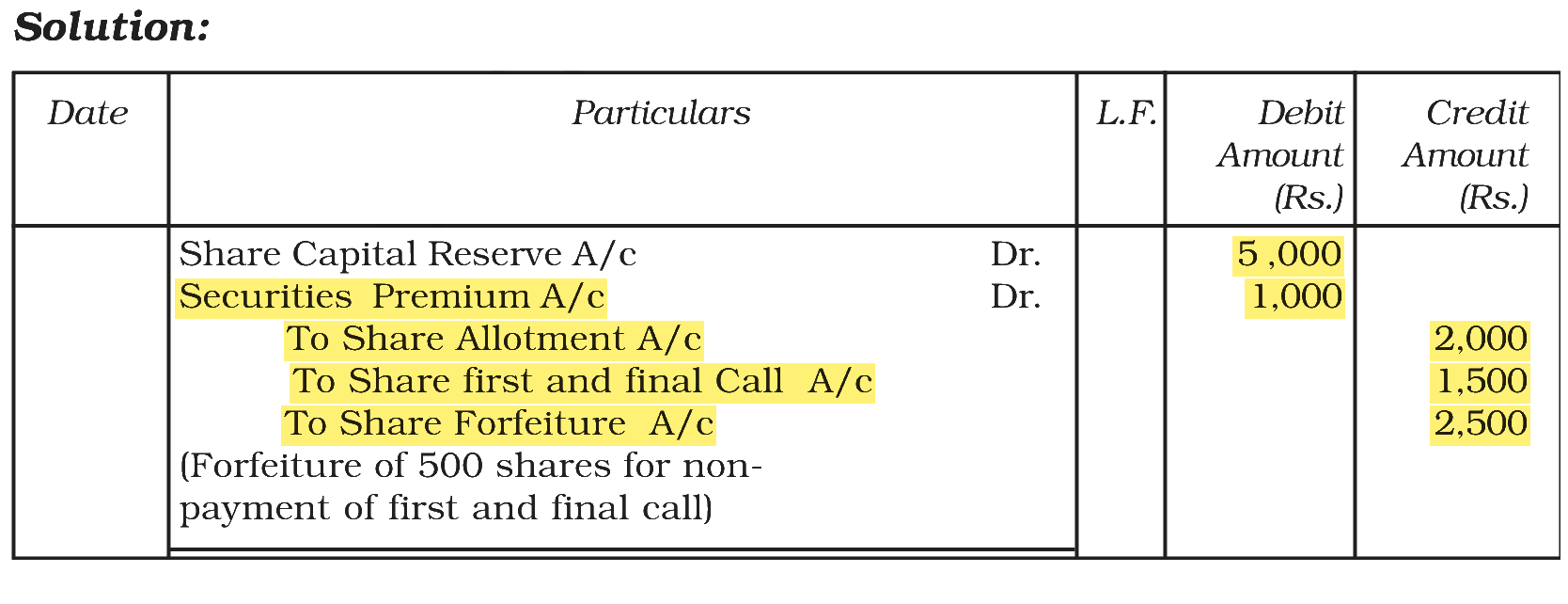
The correct answer is Option (4) → Share Capital A/c Dr. 5,000 and Securities Premium A/c Dr. 1,000, to Share Allotment A/c 2,000, to Share First and Final Call A/c 1,500 and to Share Forfeiture A/c 2,500
On forfeiture, the entries made for the forfeited shares are reversed. Share Capital is debited with the called-up amount; the unpaid calls are credited; and Share Forfeiture is credited with the money already received. Securities Premium is debited too, because the premium was due with allotment and was never received.
Share Capital (called up): 500 × Rs. 10 = Rs. 5,000 (Dr.)
Securities Premium not received: 500 × Rs. 2 = Rs. 1,000 (Dr.)
Allotment unpaid: 500 × Rs. 4 = Rs. 2,000 (Cr.)
First and final call unpaid: 500 × Rs. 3 = Rs. 1,500 (Cr.)
Application money received: Rs. 10 − Rs. 2 − Rs. 3 = Rs. 5 a share
Share Forfeiture: 500 × Rs. 5 = Rs. 2,500 (Cr.)
The debits (Rs. 6,000) equal the credits (Rs. 2,000 + Rs. 1,500 + Rs. 2,500). Option (1) swaps the call and forfeiture amounts: the forfeiture account takes the money received (Rs. 2,500), not the unpaid call.
Note: The book’s printed solution names the first debit as “Share Capital Reserve A/c”, a misprint for Share Capital A/c: there is no such account, and the forfeiture entry always debits Share Capital.
NCERT (2026-27 edition):
|