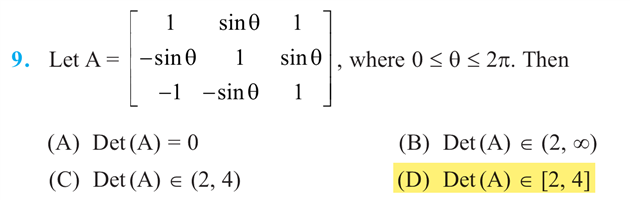
Let \(A=\begin{bmatrix}1 & \sin\theta & 1\\ -\sin\theta & 1 & \sin\theta\\ -1 & -\sin\theta & 1\end{bmatrix}\) where \(0 \le \theta \le 2\pi\). Then det(A) lies in the interval :
Answer & explanation
Correct answer: option 3
The correct answer is Option (3) → [2, 4]
Let \(s = \sin\theta\). Expanding along the first row:
\(\det(A) = 1\big(1 + s^2\big) - s\big(-s + s\big) + 1\big(s^2 + 1\big)\)
\(= 1 + s^2 - 0 + s^2 + 1\)
\(= 2 + 2\sin^2\theta\)
For \(0 \le \theta \le 2\pi\), \(\sin^2\theta\) takes every value from 0 to 1:
\(0 \le \sin^2\theta \le 1\)
\(2 \le 2 + 2\sin^2\theta \le 4\)
So det(A) lies in [2, 4]. Both ends are reached: det(A) = 2 at \(\theta = 0\) and det(A) = 4 at \(\theta = \frac{\pi}{2}\).
Why the other options are incorrect
Option (1) [2, 3] — Incorrect. det(A) goes up to 4, at \(\theta = \frac{\pi}{2}\).
Option (2) [3, 4] — Incorrect. det(A) comes down to 2, at \(\theta = 0\).
Option (4) (2, 4) — Incorrect. The open interval leaves out 2 and 4, but det(A) equals 2 at \(\theta = 0\) and 4 at \(\theta = \frac{\pi}{2}\).
NCERT (2026-27 edition):
Determinants