
CUETMOCK
  • Pricing
  • Mentors
Log inStart freeStart free mocks→

First test, then trust

Try a free CUET mock test.

Join 5,00,000+ students who rehearsed exam day on the exact NTA screen before sitting CUET. On the web and on Android.

Start free mocks →Get the Android app
CUETMOCK

India's #1 CUET Mock Test Platform. Original NCERT-based questions on the exact NTA exam screen — trusted by 5,00,000+ students since CUET 2022.

Get it onGoogle PlayScan to download the CUETMOCK app

Mock tests

  • CUET mock test series
  • Commerce mocks
  • Humanities (Arts) mocks
  • Science mocks
  • Languages & GAT mocks
  • Free practice questions
  • Pricing

Resources

  • CUET exam guide
  • CUET syllabus
  • Universities accepting CUET
  • Expert blogs
  • News & notifications
  • Webinars & counselling
  • CUET score calculator
  • How we estimate your rank
  • FAQs

Company

  • About us
  • Our leadership & team
  • Our toppers
  • Mentors
  • For schools
  • Contact us
  • Terms
  • Privacy
  • Refund policy

Talk to us

+91 7696 6630 56info@cuetmock.comWhatsApp us

Our other platforms

  • JEE Mock — For IIT-JEE aspirants
  • NEET Mock — For NEET aspirants

Newsletter

Exam updates, study material and offers — no spam.

© 2026 NYC Ventures Pvt. Ltd.

701-702, Royal Business Park, Zirakpur, Punjab - 140603

  • Terms of use
  • Privacy policy
  • Refund policy
  • Contact us

iCUETMOCK is an independent preparation platform, not affiliated with the National Testing Agency (NTA). Always check exam details on the official NTA website.

  • Home
  • Mock tests
  • CUET guide
  • Pricing
  • Log in
Home/Practice questions/General Aptitude Test
General Aptitude TestNumerical AbilityMixture and Alligation

In two containers A and B, milk and water are in the ratio 4 : 5 and…

In two containers A and B, milk and water are in the ratio 4 : 5 and 5 : 1 respectively. In what ratio both the quantity of mixture should be mixed together so that in the new mixture of ratio of milk and water will becomes 5 : 4.

Answer & explanation+

Correct answer: option 4

        Milk   :   Water

A ⇒     4    :     5     ⇒ 9  (× 2 = 18)

B ⇒     5    :     1     ⇒ 6  (× 3 = 18)

A+B ⇒ 5    :     4     ⇒ 9  (× 2 = 18)

Make all quantity equal and use allegation method:
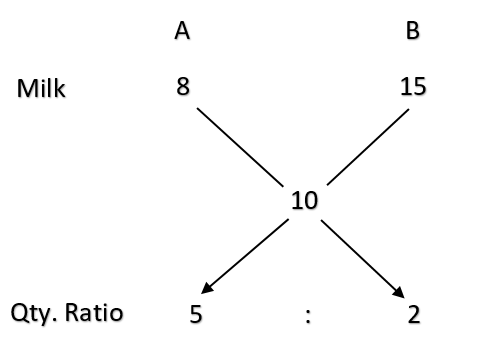
Therefore, the mixture should be mixed in the ratio 5 : 2.

Advertisement

Practise more on Numerical Ability

Chapter-wise mocks on the real NTA exam screen, with solutions and your rank. Your first mocks are free.

Start free mocks →

Advertisement

Next questions

  1. Arrange the following events in the history of intelligence testing in the correct sequence.(A) William Stern devised the concept of Intell…Psychology · Variations in Psychological Attributes
  2. To safeguard public property and to abjure violence is a _______ in the Indian Constitution.General Aptitude Test · General Knowledge
  3. If all the people in the economy increase the proportion of income they save, the total value of savings in the economy will not increase -…Economics · Macro Economics: Determination of Income and Employment
  4. Physics · Electromagnetic Waves
  5. According to the "Prayaga Prashasti," the subject's fame outshines that of other kings because of which of the following reason?History · Ancient India: Kings, Farmers and Towns
  6. If a gt b gt c gt 0 , which of the following is always positive ? (A) (a-c)÷ b (B) b+c-a (C) (c-b)×(a-b) (D) (c-b) × (b-a) (E) (a× b) - (a…Applied Maths. Section B2 · Numbers, Quantification and Numerical Applications
  7. Two statements are given followed by Three conclusions numbered I, II and III. Assuming the statements to be true, even if they seem to be…General Aptitude Test · Verbal Reasoning
  8. Inactive protoxins is converted into its active toxin by:Biology · Biotechnology and its Applications
  9. Match List -1 with List - 2 List- 1 List- 2 (A) Quebecois (I) Canada (B) Basques (II) Sri Lanka (C) Kurds (III) Northern Spain (D) Tamils (…Political Science · Nationalism
  10. Which is not a cause of disequilibrium in Balance of Payment?Economics · Macro Economics: Open Economy Macro Economics