
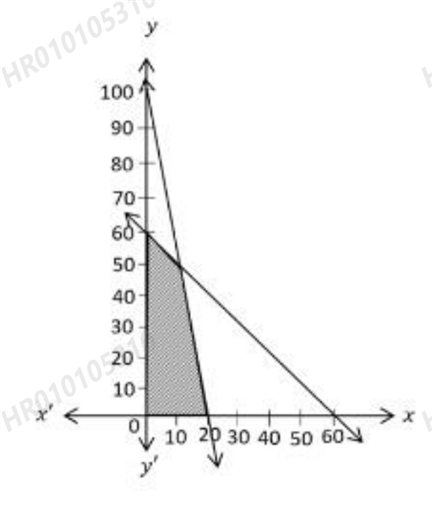
If the feasible region (shaded portion) of a LPP is as shown in the graph, then max \( z=50x+15y \) is:
Answer & explanation
Correct answer: option 2
The correct answer is Option (2) → 1250
From their intercepts, the two boundary lines are
\( \displaystyle \text{Through }(0,60)\text{ and }(60,0):\ x+y=60 \)
\( \displaystyle \text{Through }(0,100)\text{ and }(20,0):\ 5x+y=100 \)
The shaded region lies below both lines in the first quadrant. Subtracting the first equation from the second, the lines meet where
\( \displaystyle 4x=40 \)
\( \displaystyle x=10,\ y=50 \)
So the corner points are O(0, 0), A(20, 0), B(10, 50) and C(0, 60). Evaluating z = 50x + 15y:
\( \displaystyle O(0,0):\ z=0 \)
\( \displaystyle A(20,0):\ z=1000 \)
\( \displaystyle B(10,50):\ z=500+750=1250 \)
\( \displaystyle C(0,60):\ z=900 \)
The maximum value of z is 1250, at (10, 50).
Why the other options are incorrect
Option (1) 900 — Incorrect. 900 is the value at C(0, 60), which is smaller than the value at B(10, 50).
Option (3) 1500 — Incorrect. 1500 is the value at (0, 100), the y-intercept of 5x + y = 100; that point is outside the shaded region.
Option (4) 3000 — Incorrect. 3000 is the value at (60, 0), the x-intercept of x + y = 60; that point is also outside the shaded region.