The demographic indicator is related with which of the following?
Answer & explanation
Correct answer: option 3
The correct answer is Option (3) → Population and its different aspects.
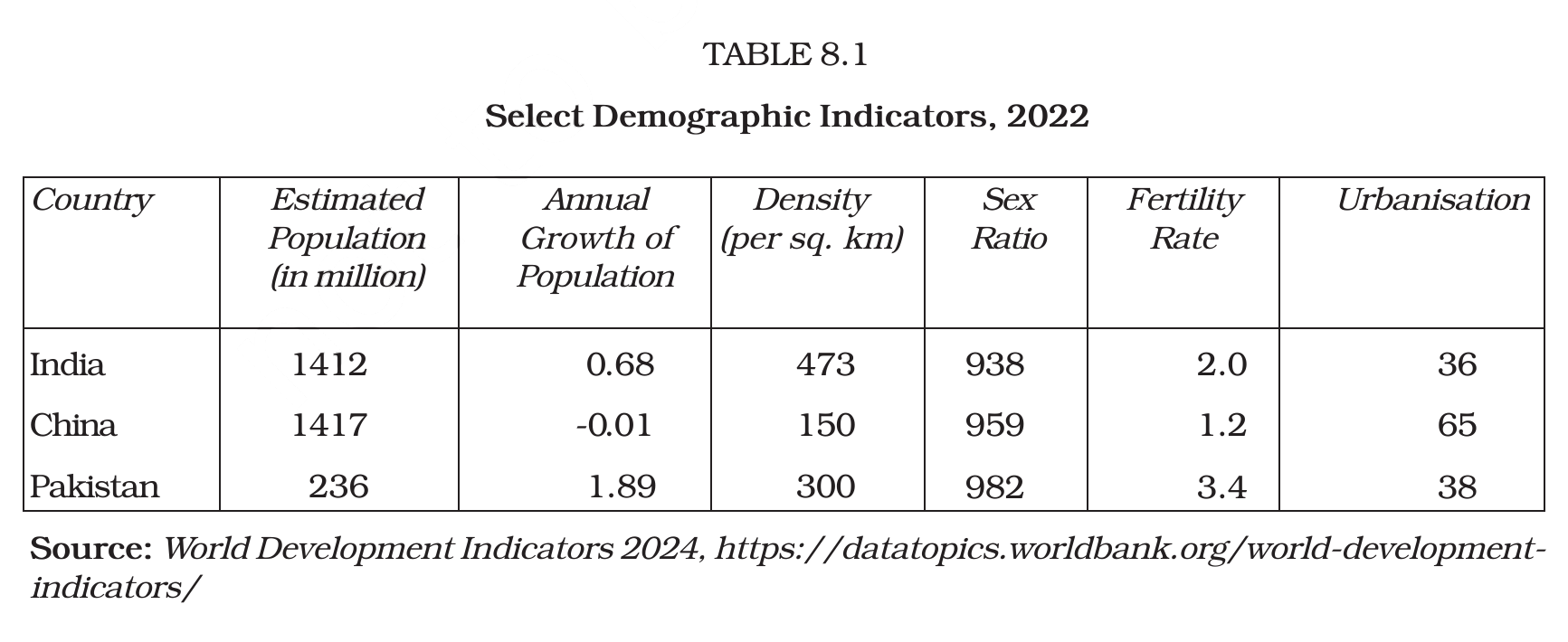
Demography is the study of population, so a demographic indicator measures the population and its different aspects: its size, its annual rate of growth, its density (persons per square kilometre), the sex ratio (females per 1000 males), the fertility rate and the degree of urbanisation.
These are the indicators used to compare India, China and Pakistan, showing for example that population growth is highest in Pakistan and that the sex ratio is biased against females in all three countries.
Why the other options are incorrect
Option (1) Saving and Investment — Incorrect. Saving and investment measure how much of income is kept aside and how much is added to the stock of capital. They are economic indicators, not features of the population.
Option (2) Foreign trade — Incorrect. Foreign trade is the exchange of goods and services with other countries, shown by exports and imports. It concerns the economy’s links abroad, not its people.
Option (4) Sectoral development — Incorrect. Sectoral development is the growth of agriculture, industry and services and their shares in output and employment. It is an economic indicator, used to compare the structure of economies rather than their populations.
NCERT (2025-26): “8.3 Demographic Indicators … If we look at the global population, out of every six persons living in this world, one is an Indian and another a Chinese. We shall compare some demographic indicators of India, China and Pakistan. The population of Pakistan is very small and accounts for roughly about one-tenth of China or India.…”
|