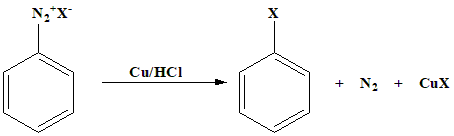
Identify the name reaction given below:
Answer & explanation
Correct answer: option 1
The correct answer is Option (1) → Gatterman Reaction
The reactions in the options introduce a group into the benzene ring in different ways:
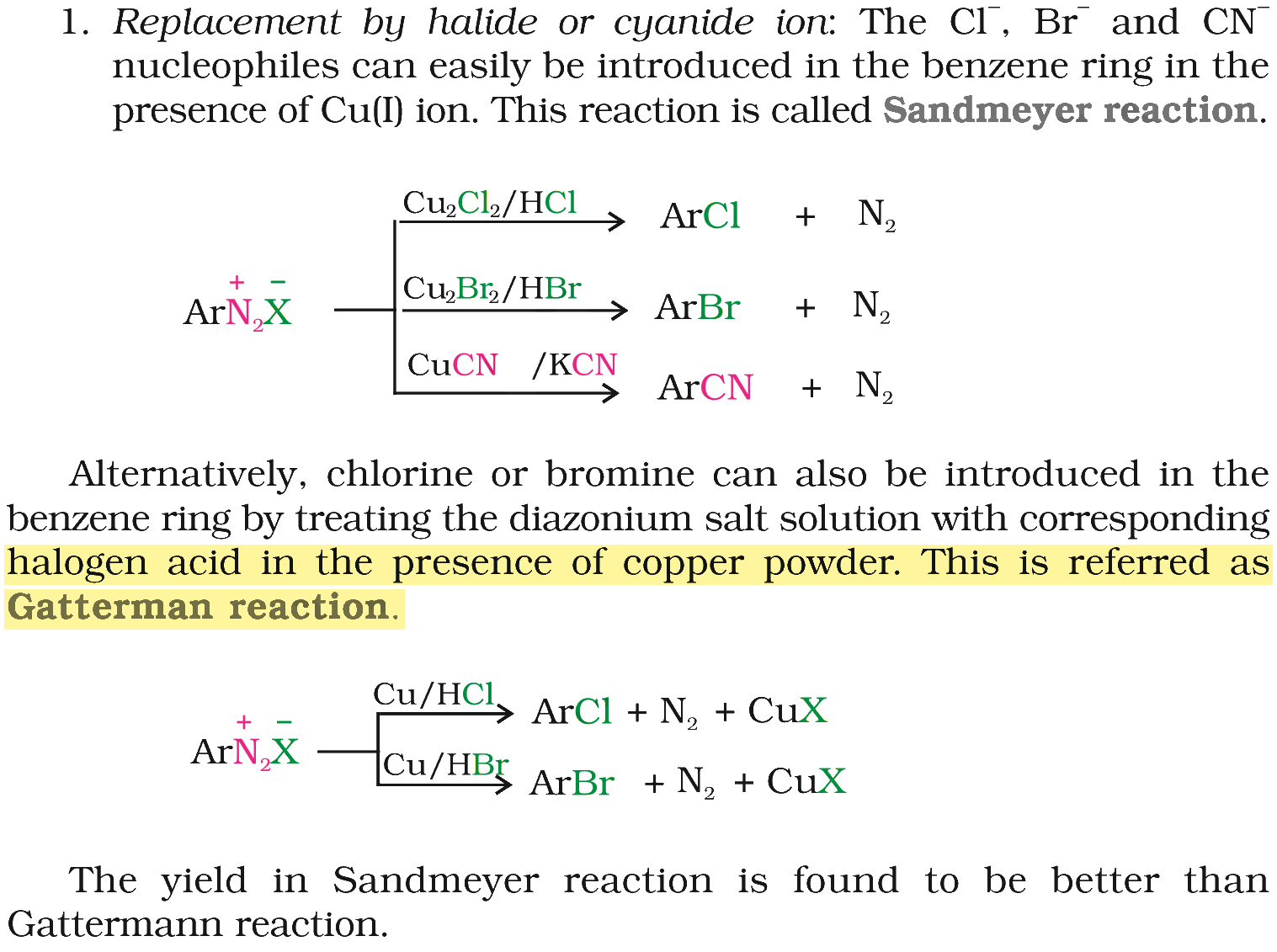
From a diazonium salt with copper(I) halide: Sandmeyer reaction, \( \ce{ArN2^{+}X^{-}} \) + \( \ce{Cu2X2} \)/HX → ArX + \( \ce{N2} \).
From a diazonium salt with copper powder and HX: Gattermann reaction, \( \ce{ArN2^{+}X^{-}} \) + Cu/HX → ArX + \( \ce{N2} \).
Formylation of benzene: Gattermann-Koch reaction, \( \ce{C6H6} \) + CO + HCl (anhyd. \( \ce{AlCl3} \)/CuCl) → \( \ce{C6H5CHO} \).
Phenol from chlorobenzene: Dow’s process, \( \ce{C6H5Cl} \) + NaOH (623 K, high pressure) → \( \ce{C6H5ONa} \) → \( \ce{C6H5OH} \).
The given reaction treats a benzenediazonium halide with copper powder and HCl; nitrogen escapes and the halogen takes its place:
\( \ce{C6H5N2^{+}X^{-}} \) + Cu/HX → \( \ce{C6H5X} \) + \( \ce{N2} \) + CuX
So it is the Gattermann reaction.
Why the other options are incorrect
Option (2) Sandmeyer Reaction — Incorrect. Also converts a diazonium salt into a haloarene, but the reagent is a copper(I) salt (\( \ce{Cu2Cl2} \)/HCl or \( \ce{Cu2Br2} \)/HBr), not copper powder; its yield is better than that of the Gattermann reaction.
Option (3) Gatterman - Koch Reaction — Incorrect. It starts from benzene, not a diazonium salt, and gives benzaldehyde with CO and HCl.
Option (4) Dow’s Process — Incorrect. It converts chlorobenzene into phenol with NaOH at high temperature and pressure.
NCERT (2026-27 edition):
Reactions Involving Displacement of Nitrogen – …