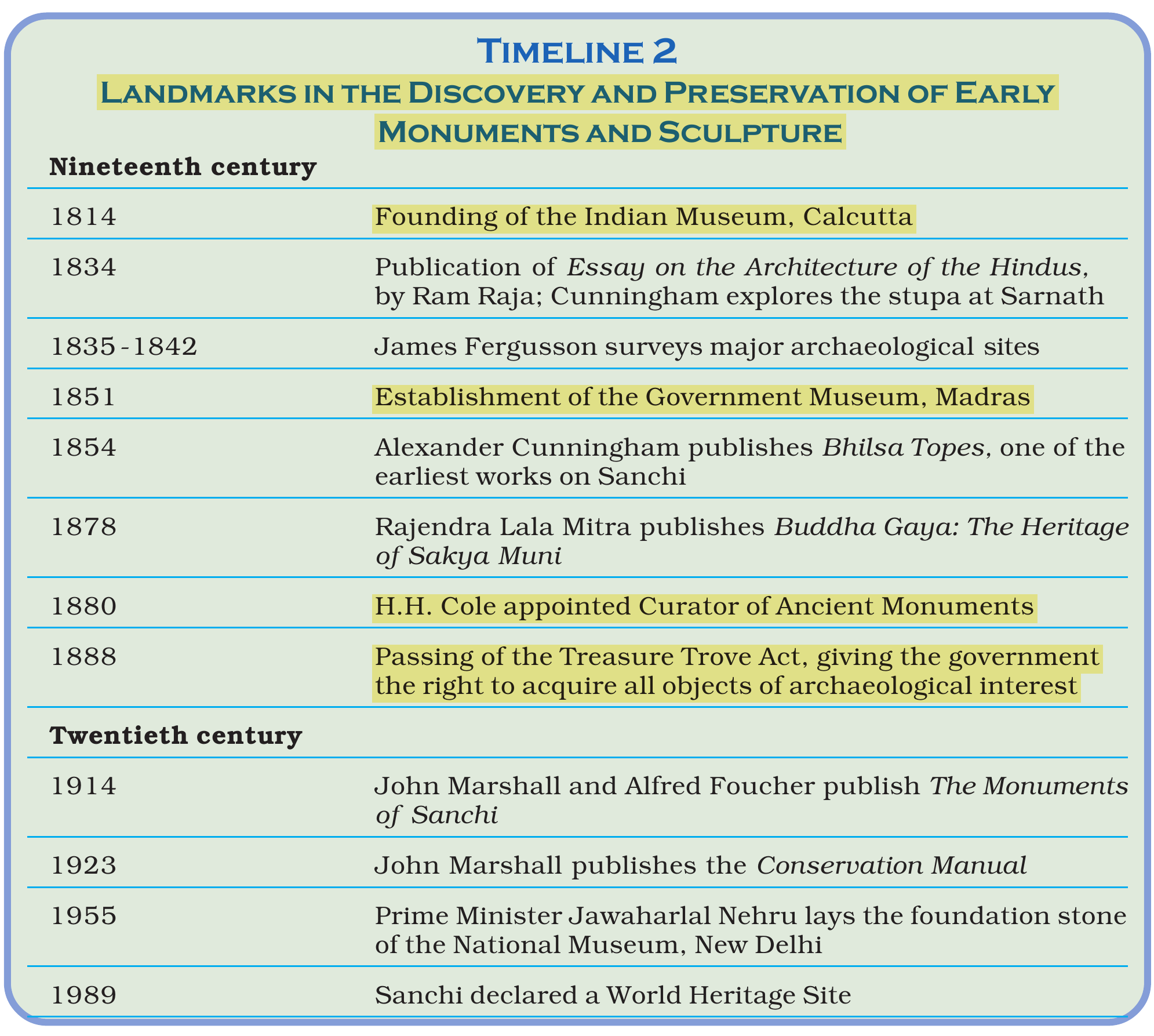
Match List-I with List-II:
| List-I Preservation of Monuments and Sculpture | List-II Year | ||
| (A) | Founding of the Indian Museum, Calcutta | (I) | 1888 |
| (B) | Establishment of the Government Museum, Madras. | (II) | 1814 |
| (C) | H.H. Cole appointed Curator of Ancient Monuments | (III) | 1851 |
| (D) | Passing of the Treasure Trove Act | (IV) | 1880 |
Choose the correct answer from the options given below:
Answer & explanation
Correct answer: option 3
The correct answer is Option (3) → (A)-(II), (B)-(III), (C)-(IV), (D)-(I)
(A) Founding of the Indian Museum, Calcutta — this matches (II) 1814. It is the earliest nineteenth-century landmark in the discovery and preservation of early monuments and sculpture.
(B) Establishment of the Government Museum, Madras — this matches (III) 1851. It came after James Fergusson’s surveys of the major archaeological sites (1835-1842).
(C) H.H. Cole appointed Curator of Ancient Monuments — this matches (IV) 1880. Cole argued that museums should keep plaster-cast copies, while the original sculptures should remain where they had been found.
(D) Passing of the Treasure Trove Act — this matches (I) 1888. The Act gave the government the right to acquire all objects of archaeological interest.
NCERT: Themes in Indian History Part I — Chapter 4: Thinkers, Beliefs and Buildings (2026-27)
|