The glycosidic linkage present in sucrose is between
Answer & explanation
Correct answer: option 1
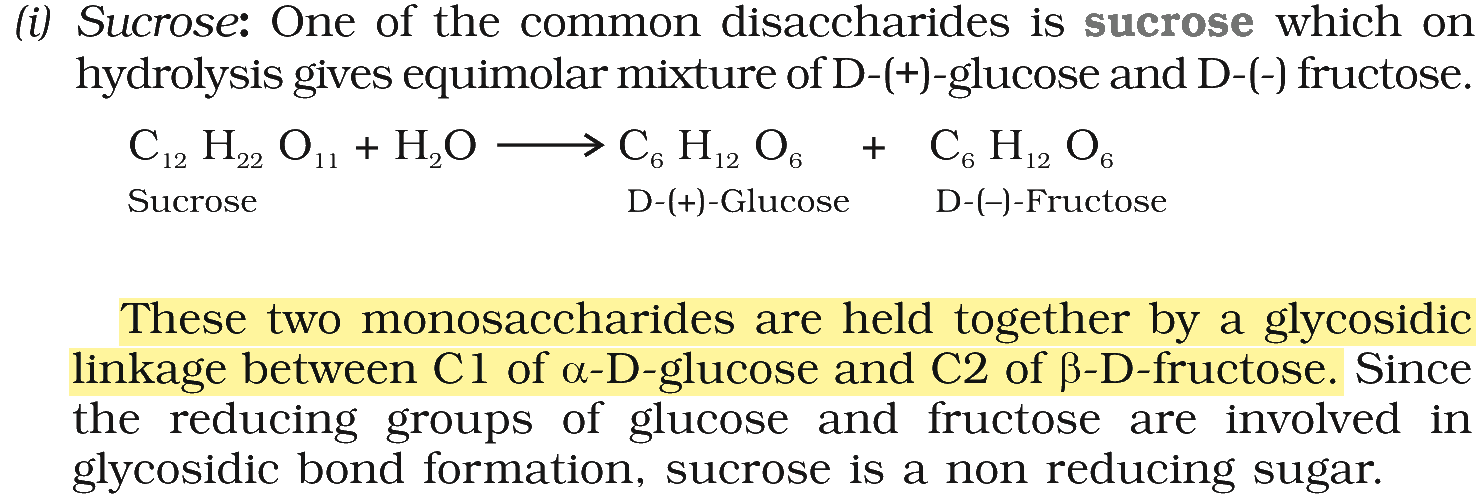
The correct answer is Option (1) → C-1 of α-glucose and C-2 of β-fructose
Disaccharides are two monosaccharide units joined by a glycosidic linkage (an oxide link formed by loss of water). Which carbons are joined decides whether the sugar is reducing:
Sucrose = α-D-glucose + β-D-fructose, joined between C1 of glucose and C2 of fructose. Both anomeric (reducing) carbons are used up, so sucrose is a non-reducing sugar.
Maltose = two α-D-glucose units, joined between C1 of one and C4 of the other; the free anomeric carbon makes it reducing.
Lactose = β-D-galactose + D-glucose, joined between C1 of galactose and C4 of glucose; also reducing.
So the glycosidic linkage in sucrose is between C-1 of α-glucose and C-2 of β-fructose.
NCERT (2026-27 edition):
Disaccharides – …