Read the passage carefully and answer the questions based on the passage:
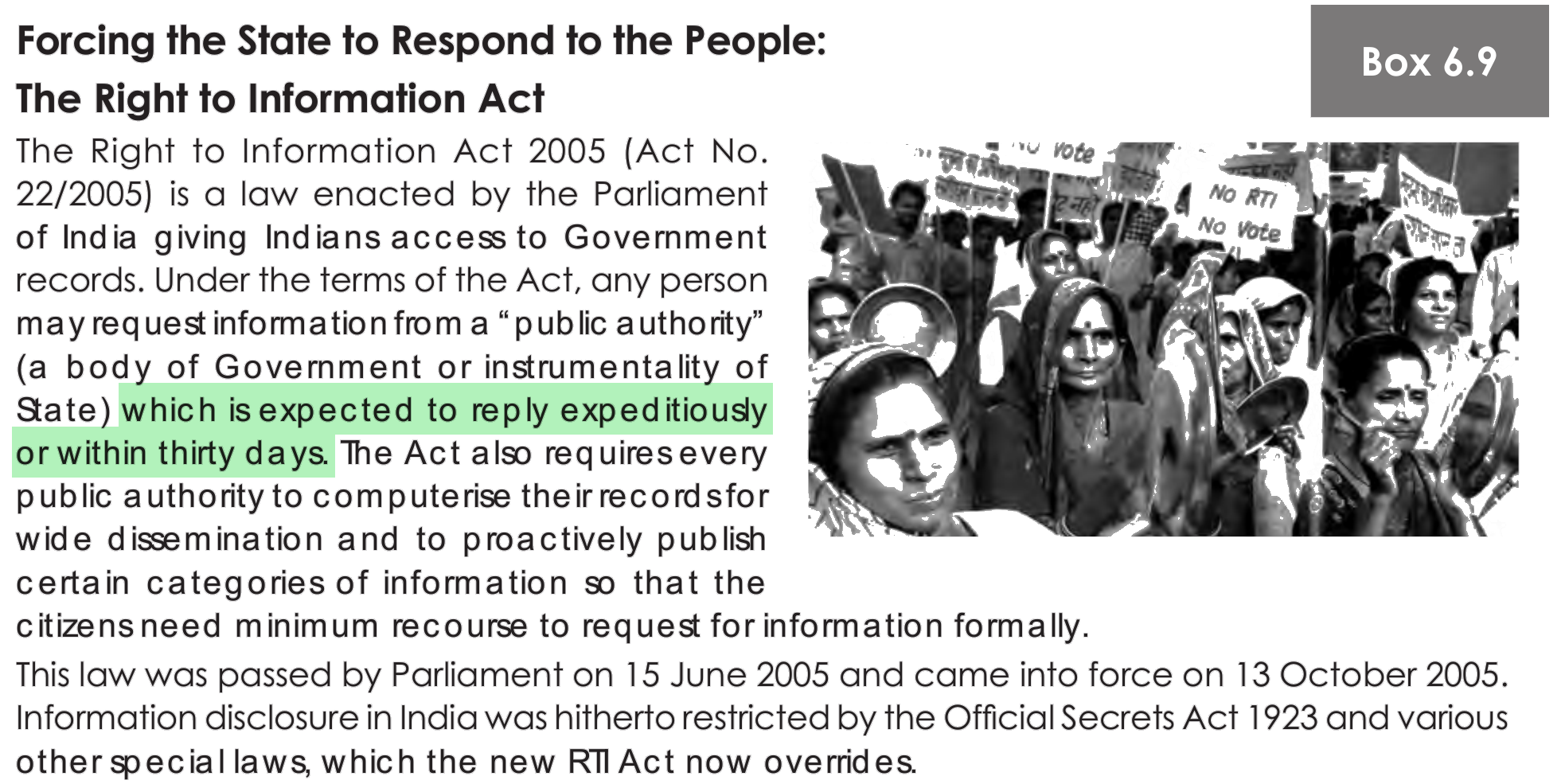
The Right to information Act 2005 (Act No. 22/2005) is a law enacted by the Parliament of India giving Indians access to government records. Under the terms of the Act, any person may request information from a "public authority" (a body of Government or instrumentality of State) which is expected to reply expeditiously or within thirty days. The Act also requires every public authority to computerize their records for wide dissemination and to proactively publish certain categories of information so that the citizens need minimum recourse to request for information formally. This law was passed by Parliament on 15 June 2005 and came into force on 13 October 2005. Information disclosure in India was hitherto restricted by the Official Secrets Act 1923 and various other special laws, which the new RTI Act now overrides. The Act specifies that citizens have a right to:
- Request any information (as defined)
- Take copies of documents
- Inspect documents, works and records
- Take certified samples of materials of work.
- Obtain information in the form of printouts, diskettes, floppies, tapes, video cassettes or in any other electronic mode.
Within how many days, a public authority is expected to reply under RTI?
Answer & explanation
Correct answer: option 3
The correct answer is Option (3) → 30 days
Note: The passage of Q6-Q10 is Box 6.9 of the NCERT chapter ‘The Challenges of Cultural Diversity’, ‘Forcing the State to Respond to the People: The Right to Information Act’, reproduced almost word for word. One box in the margin of a chapter gave five questions, so read the boxes as carefully as the main text.
NCERT: Indian Society — Chapter 6: The Challenges of Cultural Diversity (2025-26)
|