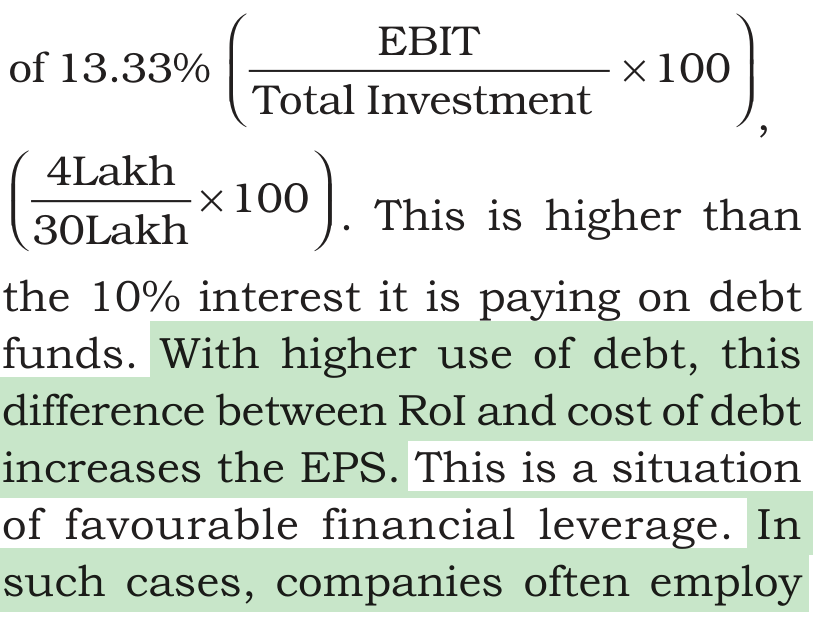
Assertion (A): When the RoI is higher than the cost of debt, a higher use of debt increases the earnings per share.
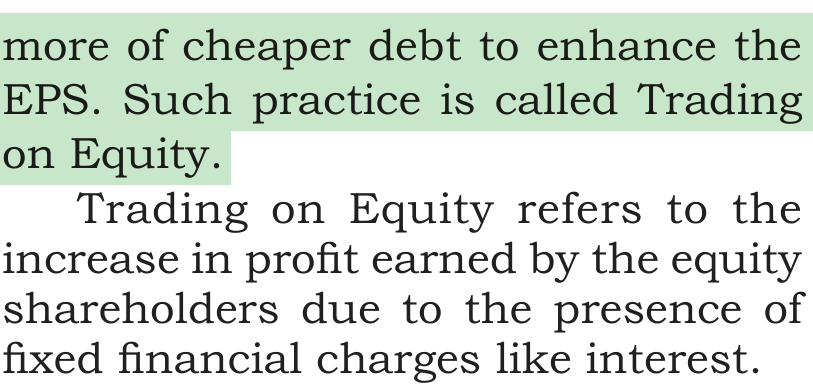
Reason (R): Companies often employ more of cheaper debt to enhance the EPS, a practice called trading on equity.
Choose the correct answer from the options given below:
Answer & explanation
Correct answer: option 2
The correct answer is Option (2) → Both (A) and (R) are true but (R) is not the correct explanation of (A).
Assertion (A): When the RoI is higher than the cost of debt, a higher use of debt increases the earnings per share. — True. RoI is the return the company earns on all its funds. When it is above the interest rate, borrowed funds earn more than they cost. The surplus goes to the equity shareholders, so the EPS rises. This is favourable financial leverage.
Reason (R): Companies often employ more of cheaper debt to enhance the EPS, a practice called trading on equity. — True. Using more cheap debt to raise the EPS is called trading on equity.
Why R does not explain A?
R only names the practice that companies follow. It does not say why the EPS rises. The cause in A is the gap between RoI and the cost of debt. Each rupee of debt earns more than the interest paid on it, and this surplus raises the earnings of each equity share.
NCERT (2026-27 Edition): “EBIT-EPS Analysis … Three situations are considered. There is no debt in situation-I i.e. (unlevered business). Debt of Rs. 10 lakh and 20 lakh are assumed in situations-II and III, respectively. All debt is at 10% p.a. The company earns Rs. 0.93 per share if it is unlevered. With debt of Rs. 10 lakh its EPS is Rs. 1.05. With a still higher debt of Rs. 20 lakh, its, EPS rises to Rs. 1.40. Why is the EPS rising with higher debt? It is because the cost of debt is lower than the return that company is earning on funds employed. The company is earning a Return on Investment (RoI). …”
|