
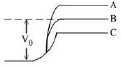
In the figure \( V_0 \) is the potential barrier across a p-n junction, when no battery is connected across the junction. Effective barrier potential heights A and C are found when p-n junction is biased. Choose the correct option.
Answer & explanation
Correct answer: option 2
The correct answer is Option (2) → C corresponds to forward bias and A to reverse bias.
The height of the potential barrier of a p-n junction changes with the applied bias. Forward bias opposes the built-in potential and lowers the barrier to \( V_0 - V \). Reverse bias adds to the built-in potential and raises the barrier to \( V_0 + V \).
In the figure the level \( V_0 \) is marked by the dashed line. Curve C reaches a height below this level, so the barrier is lower than \( V_0 \) and the junction is forward biased. Curve A reaches a height above it, so the barrier is higher than \( V_0 \) and the junction is reverse biased.
NCERT (2026-27):
p-n Junction Diode Under Forward Bias – “… The effective barrier height under forward bias is (V0 – V ).”
p-n Junction Diode Under Reverse Bias – “… As a result, the barrier height increases and the depletion region widens due to the change in the electric field.”