
CUETMOCK
  • Pricing
  • Mentors
Log inStart freeStart free mocks→

First test, then trust

Try a free CUET mock test.

Join 5,00,000+ students who rehearsed exam day on the exact NTA screen before sitting CUET. On the web and on Android.

Start free mocks →Get the Android app
CUETMOCK

India's #1 CUET Mock Test Platform. Original NCERT-based questions on the exact NTA exam screen — trusted by 5,00,000+ students since CUET 2022.

Get it onGoogle PlayScan to download the CUETMOCK app

Mock tests

  • CUET mock test series
  • Commerce mocks
  • Humanities (Arts) mocks
  • Science mocks
  • Languages & GAT mocks
  • Free practice questions
  • Pricing

Resources

  • CUET exam guide
  • CUET syllabus
  • Universities accepting CUET
  • Expert blogs
  • News & notifications
  • Webinars & counselling
  • CUET score calculator
  • How we estimate your rank
  • FAQs

Company

  • About us
  • Our leadership & team
  • Our toppers
  • Mentors
  • For schools
  • Contact us
  • Terms
  • Privacy
  • Refund policy

Talk to us

+91 7696 6630 56info@cuetmock.comWhatsApp us

Our other platforms

  • JEE Mock — For IIT-JEE aspirants
  • NEET Mock — For NEET aspirants

Newsletter

Exam updates, study material and offers — no spam.

© 2026 NYC Ventures Pvt. Ltd.

701-702, Royal Business Park, Zirakpur, Punjab - 140603

  • Terms of use
  • Privacy policy
  • Refund policy
  • Contact us

iCUETMOCK is an independent preparation platform, not affiliated with the National Testing Agency (NTA). Always check exam details on the official NTA website.

  • Home
  • Mock tests
  • CUET guide
  • Pricing
  • Log in
Home/Practice questions/Chemistry
ChemistryInorganic: Coordination Compounds

Statement I: [Co(en)2(NH3)Br]SO4 has a lower electrical conductivity…

Statement I: [Co(en)2(NH3)Br]SO4 has a lower electrical conductivity in solution than [Co(en)2(NH3)(SO4)]Br.

Statement II: In solution, [Co(en)2(NH3)Br]SO4 and [Co(en)2(NH3)(SO4)]Br give the same number of ions per formula unit.

Answer & explanation+

Correct answer: option 4

The correct answer is Option (4) → Statement I is incorrect but Statement II is correct.

The two compounds are ionisation isomers: the \( \ce{Br^-} \) and \( \ce{SO4^2-} \) groups swap places between the coordination sphere and the counter ion. In solution, only the counter ion separates from the complex entity:

    \( \displaystyle \ce{[Co(en)2(NH3)Br]SO4 -> [Co(en)2(NH3)Br]^2+ + SO4^2-} \)

    \( \displaystyle \ce{[Co(en)2(NH3)(SO4)]Br -> [Co(en)2(NH3)(SO4)]^+ + Br^-} \)

Statement I: [Co(en)2(NH3)Br]SO4 has a lower electrical conductivity in solution than [Co(en)2(NH3)(SO4)]Br. — False. Both give two ions, but the first gives doubly charged ions (2+ and 2−) while the second gives singly charged ones. A doubly charged ion carries more charge and conducts more: the sulphate ion has a limiting molar conductivity of 160.0 S cm2 mol−1 against 78.1 for the bromide ion. So the first compound conducts more, not less.

Statement II: In solution, [Co(en)2(NH3)Br]SO4 and [Co(en)2(NH3)(SO4)]Br give the same number of ions per formula unit. — True. Each gives one complex ion and one counter ion, as the equations show.

NCERT (2026-27 edition):
5.4.5 Ionisation Isomerism – “This form of isomerism arises when the counter ion in a complex salt is itself a potential ligand and can displace a ligand which can then become the counter ion. An example is provided by the ionisation isomers [Co(NH3)5(SO4)]Br and [Co(NH3)5Br]SO4.”

2.4.2 Variation of Conductivity and Molar Conductivity with Concentration – “… The law states that limiting molar conductivity of an electrolyte can be represented as the sum of the individual contributions of the anion and cation of the electrolyte. … …”

Table 2.4: Limiting Molar Conductivity for some Ions in Water at 298 K
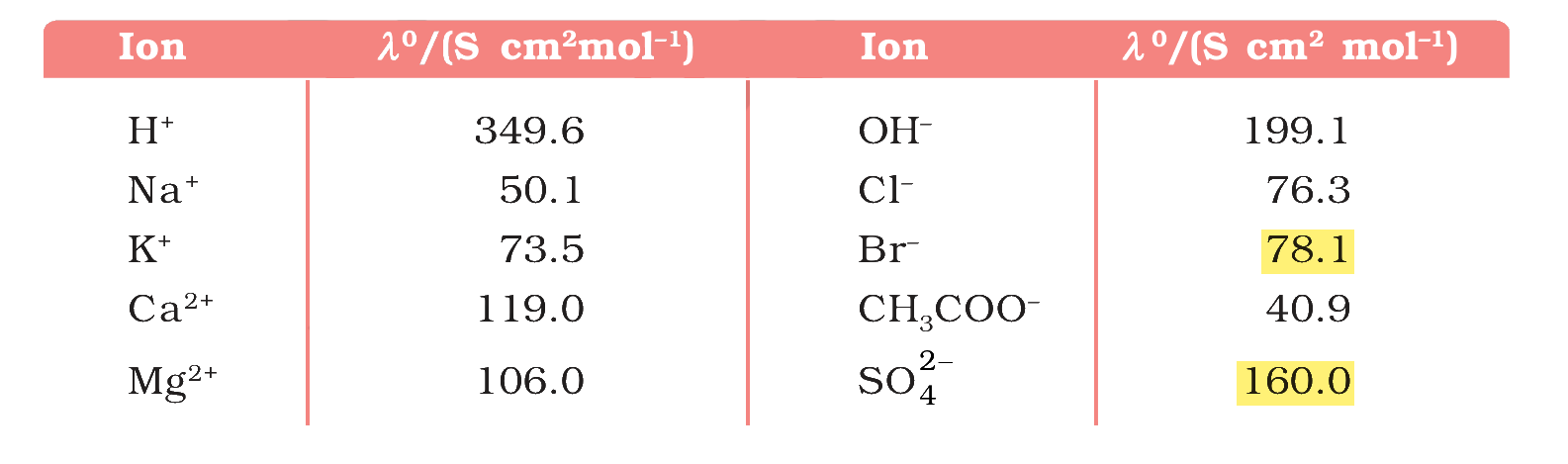
Table 2.4

Advertisement

Practise more on Inorganic: Coordination Compounds

Chapter-wise mocks on the real NTA exam screen, with solutions and your rank. Your first mocks are free.

Start free mocks →

Advertisement

Next questions

  1. Which of the following statements is correct?Statement A- The Atlantic Charter was released by U.S. President Franklin D. Roosevelt and Bri…Political Science · Contemporary World Politics: International Organisations
  2. Fill in the blank with an appropriate option. He could feel every _______ and artery in his body.English · Fill Blanks
  3. Among animals ,which of the taxonomic group has the most species richness?Biology · Biodiversity and Conservation
  4. Before the advent of the British rule, the worldwide market for India’s handicraft products rested mainly on which of the following?Economics · Indian Economic Development: Indian Economy on the Eve of Independence
  5. Three different positions of the same dice are shown. Find the number on the face opposite the face showing '4'.General Aptitude Test · Verbal Reasoning
  6. Pawan sells his goods at 15% loss on selling price. Find his actual loss %.General Aptitude Test · Numerical Ability
  7. Ram borrowed a sum of ₹5000 from bank at simple interest after 3 years he paid ₹300 to the bank and at the end of 5 years he paid ₹3300 and…General Aptitude Test · Numerical Ability
  8. In the economic crisis of 1991, what happened to the foreign exchange reserves of India?Economics · Indian Economic Development: Liberalisation, Privatisation and Globalisation - An Appraisal
  9. A bar magnet is cut into two equal halves along a plane parallel to the magnetic axis. The one parameter which remains unchanged isPhysics · Magnetism and Matter
  10. Which of the following metal ions does not show color in aqueous medium?Chemistry · Inorganic: D and F Block Elements