The correct expression for osmotic pressure of the solution involving dissociation of the solute is
Answer & explanation
Correct answer: option 4
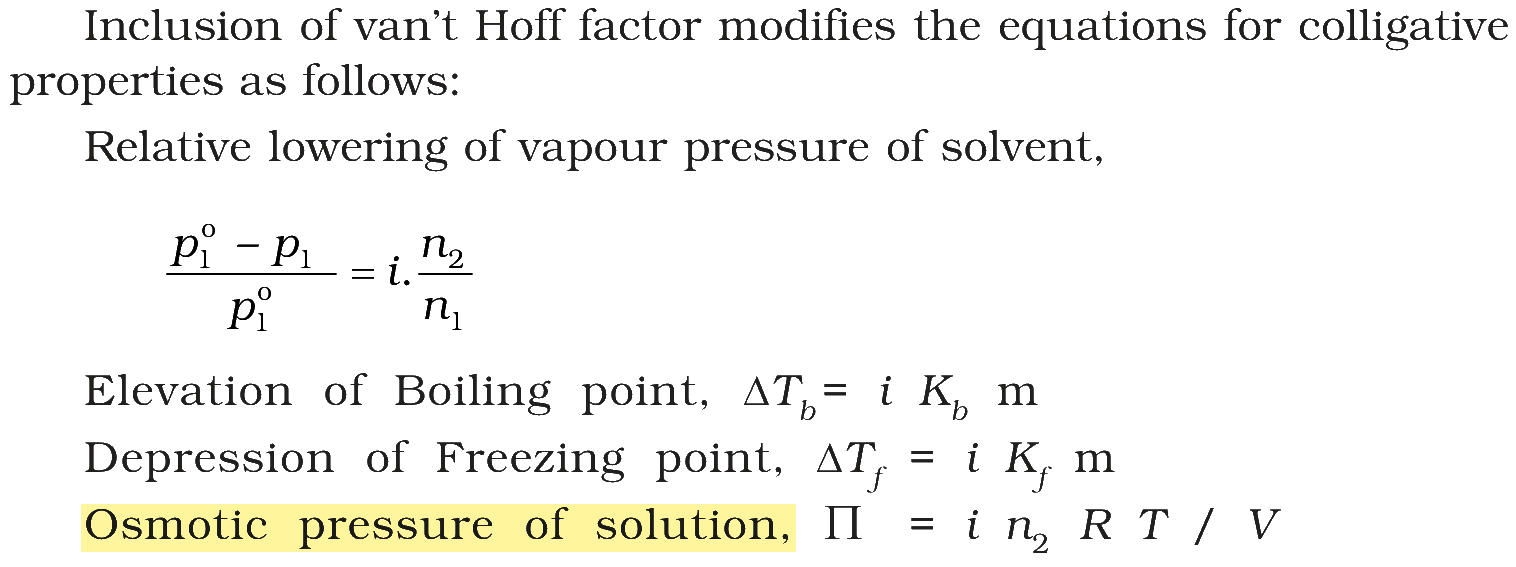
The correct answer is Option (4) → \(π=\frac{in_2RT}{V}\)
For a solution of a non-electrolyte, the osmotic pressure is proportional to the molar concentration of the solute:
\( \displaystyle \pi = CRT = \frac{n_2}{V}RT \)
where \( n_2 \) is the number of moles of solute and V the volume of the solution. Osmotic pressure is a colligative property, so it depends on the number of solute particles. When the solute dissociates, each mole gives i moles of particles, where i is the van’t Hoff factor, so \( n_2 \) is replaced by \( i\,n_2 \):
\( \displaystyle \pi = \frac{i\,n_2RT}{V} \)
So Option (4) is the correct expression.
Why the other options are incorrect
Option (1) \(π=\frac{ic_2RT}{V}\) — Incorrect. \( c_2 \) is already a concentration (moles per volume); dividing it by V again gives the wrong units.
Option (2) \(π=ic_2RTV\) — Incorrect. Multiplying by the volume is wrong; the correct form with concentration is \( \pi = i\,c_2RT \).
Option (3) \(π=\frac{n_2RT}{V}\) — Incorrect. This holds only for a solute that does not dissociate (i = 1); it leaves out the van’t Hoff factor.
NCERT (2026-27 edition):
Abnormal Molar Masses – …