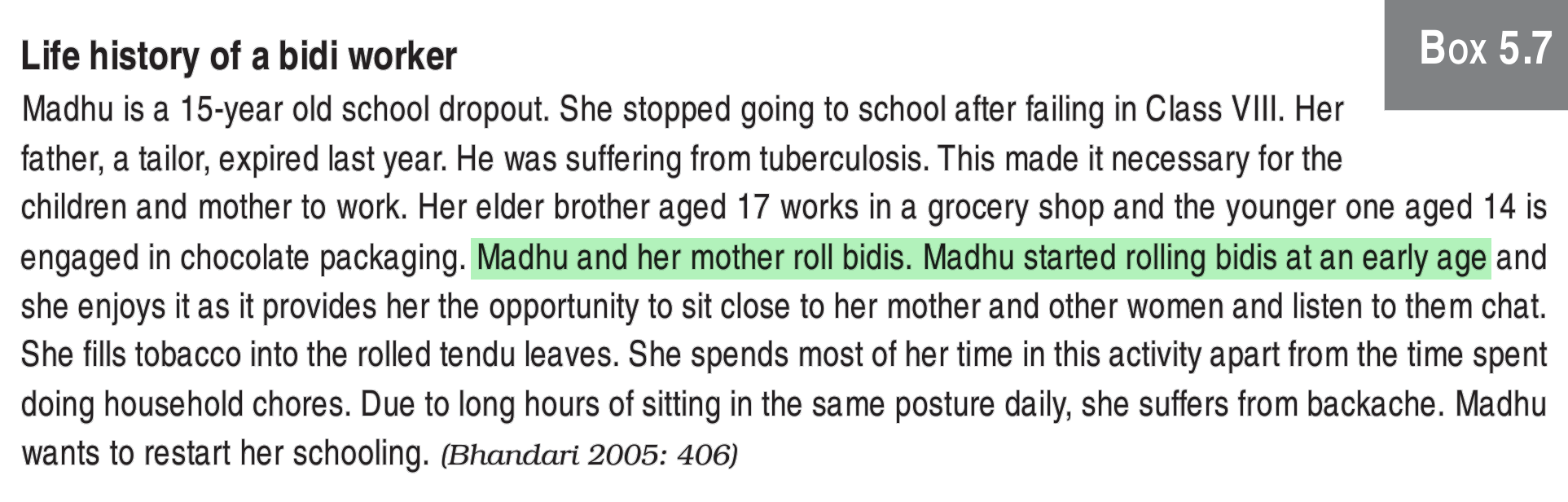
Madhu started rolling bidis when she was very young and gets paid on the number of bundles she makes in a week. This is called:
A. piece-rate work
B. informal work
C. independent work
D. home-based work
Choose the correct answer from the options given below:
Answer & explanation
Correct answer: option 1
The correct answer is Option (1) → A, D, B only
A. piece-rate work Correct. Madhu is paid on the number of bundles she makes. Home workers are paid on a piece-rate basis, depending on the number of pieces they make, not on the hours they work.
B. informal work Correct. The organised sector consists of units employing ten or more people throughout the year. Work done at home, with no regular employer or contract, belongs to the unorganised or informal sector, where over 90% of India’s work lies.
C. independent work Incorrect. Madhu does not work for herself. In home-based work an agent provides the raw materials and picks up the finished product, and pays for each piece, so she works for the bidi trade, not as an independent worker setting her own terms.
D. home-based work Correct. Home-based work includes the manufacture of lace, zari, carpets, bidis and agarbattis, and it is mainly done by women and children, as Madhu began doing when she was very young.
Note 1: Madhu’s story is from Box 5.7, ‘Life history of a bidi worker’, of the chapter ‘Change and Development in Industrial Society’ in the pre-rationalised NCERT, which NTA followed in 2023. The box has been deleted from the NCERT book (2025-26), though the chapter and its section on home-based work are still there.
Note 2: This is an application-based question. The book explains home-based work, the piece-rate basis of payment and the unorganised or informal sector; it does not use the phrase ‘independent work’. The answer comes from applying these ideas to Madhu’s case: she rolls bidis at home, is paid by the bundle, and has no regular employer, while the agent who supplies and collects the work means she is not independent.
NCERT (2025-26): “The Specificity of Indian Industrialisation … Economists and others often make a distinction between the organised or formal and unorganised or informal sector. There is a debate over how to define these sectors. According to one definition, the organised sector consists of all units employing ten or more people throughout the year. These have to be registered with the government to ensure that their employees get proper salaries or wages, pension and other benefits. In India, over 90% of the work, whether it is in agriculture, industry or services is in the unorganised or informal sector.…” “5.6 Home-based work … Home-based work is an important part of the economy. This includes the manufacture of lace, zari or brocade, carpets, bidis, agarbattis and many such products. This work is mainly done by women and children. An agent provides raw materials and also picks up the finished product. Home workers are paid on a piece-rate basis, depending on the number of pieces they make.…”
Box 5.7, Life history of a bidi worker (Pre-rationalised NCERT) |