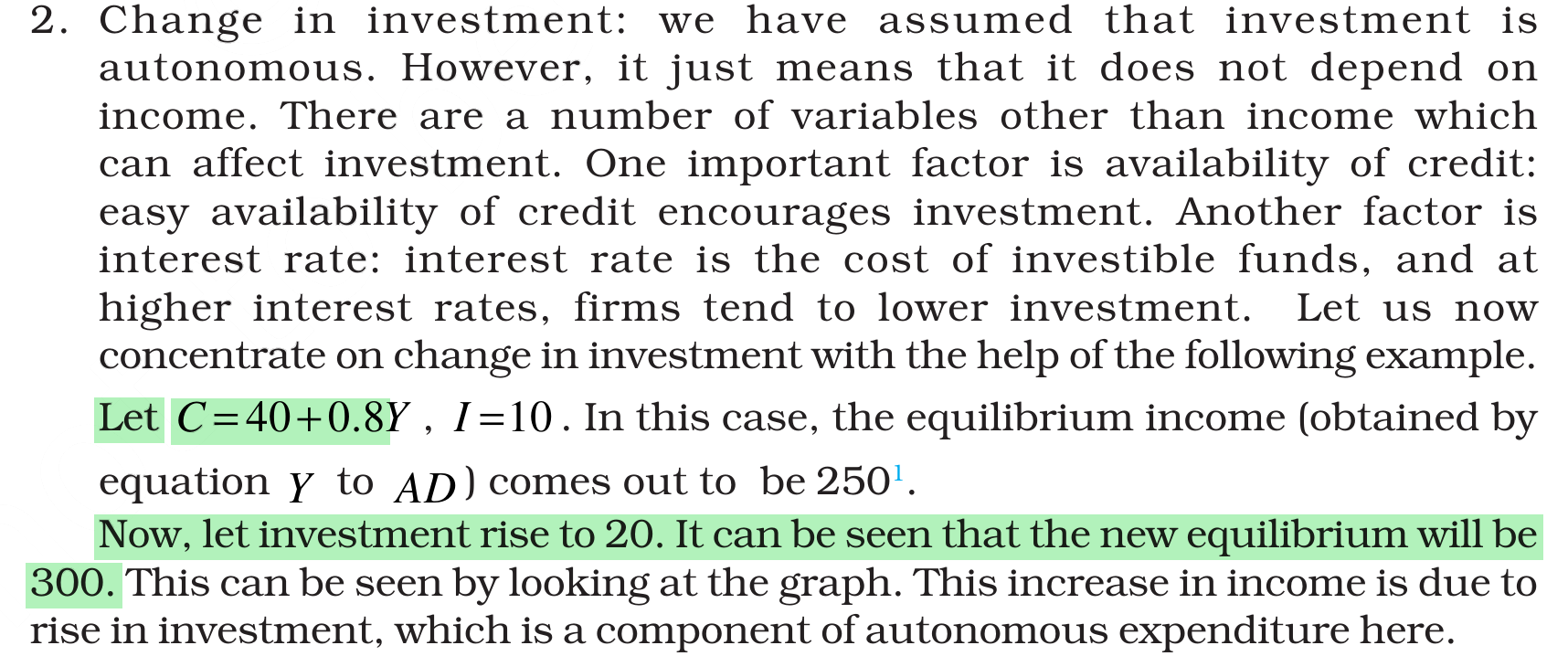
What will be the difference between original and the new equilibrium level of income, when the investment rises from 10 to 20 at given consumption function C= 40 + 0.8Y?
Answer & explanation
Correct answer: option 1
The correct answer is Option (1) → 50
Extra investment becomes income for households, who spend a part of it (the MPC), and that spending becomes someone else’s income in the next round. So income rises by a multiple of the rise in investment, the investment multiplier 1 ÷ (1 − MPC).
Given:
Consumption function C = 40 + 0.8Y, so MPC (c) = 0.8
Investment rises from 10 to 20, so ΔI = 10
Working it out:
Multiplier = 1 ÷ (1 − 0.8) = 1 ÷ 0.2 = 5
ΔY = 5 × 10 = 50, which is Option (1)
Check from the two equilibria:
Original: Y = 40 + 0.8Y + 10, so 0.2Y = 50 and Y = 250
New: Y = 40 + 0.8Y + 20, so 0.2Y = 60 and Y = 300
Difference = 300 − 250 = 50; 300 (Option 4) is the new level of income, not the difference.
NCERT: Introductory Macroeconomics — Chapter 4: Determination of Income and Employment (2025-26)
|